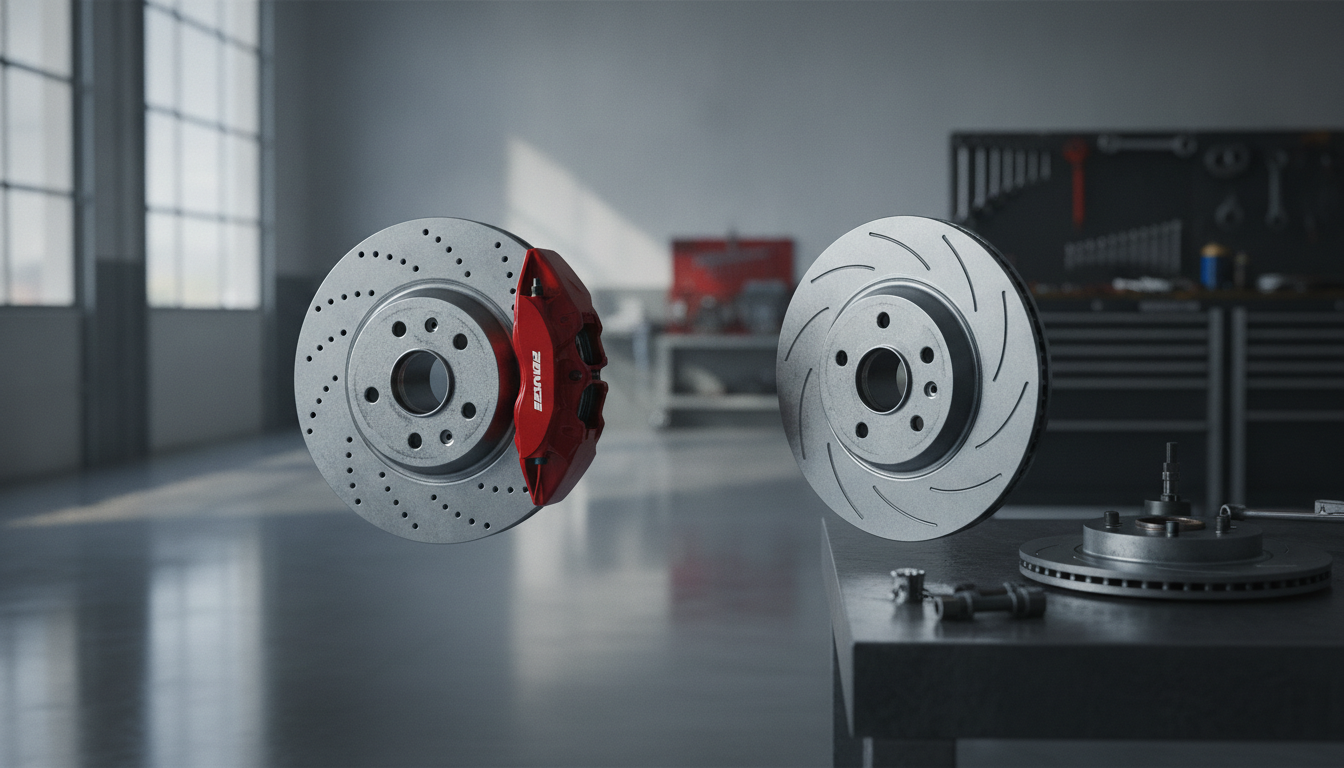
Why this matters for your vehicle
Choosing the right brake rotors is more than just picking a shiny part. It directly impacts how your vehicle stops, how long your brake components last, and ultimately, your safety. Rotors are the workhorses that your brake pads clamp down on, converting kinetic energy into heat. How well they manage that heat, clear away friction material dust, and maintain consistent contact with the pads directly affects your braking performance. Different rotor designs, like drilled, slotted, or blank, each handle these tasks in their own way, with specific trade-offs.
Understanding these differences helps you match your brakes to your driving style. If you're just commuting, a basic blank rotor might be all you need. But if you haul heavy loads, drive aggressively, or hit the track, you'll want something that can handle more heat and maintain better pad bite. It's about getting the right tool for the job, ensuring your vehicle stops predictably every time.
Before you start: when NOT to DIY
While swapping rotors isn't the hardest job, there are times when you should just take your vehicle to a professional shop. If you're seeing any of these red flags, it's best to let someone with specialized equipment and experience handle it.
- Seized calipers: If your caliper pistons are stuck or the guide pins are completely frozen, you might need more than just a rotor swap. Trying to force it can damage other components.
- Damaged brake lines: Any signs of a leaking or corroded brake line, like the Ags Poly-Armour Brake Line, means you're dealing with a hydraulic issue that requires careful attention and proper bleeding procedures.
- ABS or traction control lights on: These indicate a deeper electronic issue that a simple rotor replacement won't fix. You need diagnostic tools to figure out what's going on.
- Excessive rust or seized fasteners: If bolts are completely rusted solid and won't budge even with penetrating oil, you risk snapping them. That turns a simple job into a major headache.
- Lack of proper tools: If you don't have a torque wrench, jack stands, or other necessary safety equipment, don't start the job. Safety first.
Step-by-step procedure
Step 1 — Understand your current setup Before you even think about upgrading, know what you're running now. Most vehicles come with blank rotors from the factory. These are solid discs of cast iron, designed for everyday driving. They're reliable, quiet, and usually the most cost-effective option. Take a close look at your existing rotors for signs of wear like deep grooves, cracks, or excessive rust. This helps you understand if your current setup is even adequate for your needs.
Step 2 — Evaluate blank rotors Blank rotors are the baseline. They offer the largest surface area for the brake pads to grip, which means consistent friction and good heat dissipation for typical driving conditions. They're generally quiet and last a long time. For most daily drivers, commuters, and even light-duty trucks, blank rotors are perfectly sufficient. They're also usually the cheapest option, which is a bonus. If you're not experiencing fade or excessive wear, sticking with blank rotors is a smart choice.
Step 3 — Consider slotted rotors Slotted rotors feature channels cut into the rotor surface. These slots serve a few key purposes. They help wipe away gas and dust that builds up between the pad and rotor, maintaining a cleaner contact patch. This can improve initial bite and wet weather performance. Slots also help dissipate heat, though not as effectively as drilled holes. The main benefit is consistency and less fade during spirited driving or light track use. I've found that slotted rotors are a great middle-ground for drivers who want a bit more performance without the potential downsides of drilled rotors.
Step 4 — Look at drilled rotors Drilled rotors have holes bored through the rotor face. The original idea was to vent heat and gases, similar to slots. They definitely look aggressive and are often associated with high-performance vehicles. Drilled rotors can offer good initial bite and some heat dissipation. However, under extreme heat and stress, the holes can become stress points and lead to cracking. This is especially true for rotors that are drilled after casting, rather than cast with the holes already in place. For serious track use or heavy towing, drilled-only rotors might not be the most durable choice.
Step 5 — Explore drilled and slotted rotors Many aftermarket performance rotors combine both drilling and slotting. The idea here is to get the best of both worlds: the heat dissipation and aggressive look of drilled rotors, with the gas and dust clearing benefits of slots. These are often a good compromise for performance street cars or vehicles that see occasional track time. They tend to be more expensive than blank or even single-feature rotors, but offer a balanced performance upgrade.
Step 6 — Understand the trade-offs Every rotor design has its pros and cons. Blank rotors are durable and cost-effective but offer no special performance benefits. Slotted rotors improve pad bite and wet performance but can be a bit noisier and wear pads slightly faster. Drilled rotors look great and dissipate heat, but the holes can crack. Combination rotors balance these, but come at a higher price. There's no single "best" rotor; it's about matching the rotor to your vehicle's demands and your driving habits.
Step 7 — Don't forget quality Regardless of the design you choose, rotor quality matters. Cheap rotors can warp, crack, or wear out quickly. Look for reputable brands and good quality cast iron. Even a simple component like a Raybestos Drum Brake Hold Down Spring Pin Kit can make a difference in a drum brake system, highlighting that quality matters across all brake components. Good quality means better heat management, longer life, and safer braking.
Step 8 — Consider your pads Your rotors and pads work together as a system. If you upgrade your rotors, you should also consider upgrading your brake pads. Performance rotors often pair best with performance pads (e.g., ceramic or semi-metallic compounds designed for higher heat). Putting aggressive pads on basic blank rotors, or vice-versa, can lead to suboptimal performance and accelerated wear. Match them up for the best results.
Bedding-in the new pads
After installing new rotors and pads, you need to properly "bed them in." This process transfers a thin layer of friction material from the pads to the rotor surface, creating an even contact patch and maximizing braking performance. The general procedure is to perform 15 to 20 medium-firm stops from 50 mph down to 30 mph, with about 30 seconds of cruising between each stop to allow the brakes to cool. Avoid coming to a complete stop during this process if possible, and don't slam on the brakes hard. After the bedding-in procedure, let the brakes cool completely for at least an hour before normal driving.
How often to replace front brake pads
Brake pad life varies wildly depending on your driving style, vehicle weight, and the type of pads you use. Generally, front brake pads last anywhere from 30,000 to 70,000 miles. You'll know it's time to replace them when you hear a squealing sound (from the wear indicator), feel a pulsation in the pedal, or notice a significant decrease in braking performance. Visually inspecting your pads during tire rotations is the best way to monitor their wear. Don't wait until you hear grinding, as that means you're likely damaging your rotors too.
Top picks



Frequently asked questions
Do drilled or slotted rotors wear out brake pads faster?
Yes, both drilled and slotted rotors can cause brake pads to wear slightly faster than blank rotors. The edges of the slots and holes act like a grater, abrading the pad surface more aggressively. This is a trade-off for improved initial bite and gas/dust clearing, but the difference is often minor for street driving.
Are drilled rotors more prone to cracking?
Drilled rotors can be more prone to cracking, especially if the holes are drilled after the rotor is cast, rather than being cast into the rotor itself. The holes create stress points that, under extreme heat and repeated stress, can lead to cracks propagating from the holes. This is less of an issue for daily driving but a concern for heavy track use.
Can I mix and match different rotor types?
It's generally not recommended to mix and match different rotor types on the same axle (e.g., a drilled rotor on one side and a blank rotor on the other). This can lead to uneven braking performance and potentially pull the vehicle to one side. It's best to use the same type of rotor on both sides of an axle for consistent braking.
What's the best rotor type for heavy towing?
For heavy towing, blank or slotted rotors are generally preferred over drilled-only rotors. Blank rotors offer maximum thermal mass and durability. Slotted rotors help clear gas and dust, maintaining consistent pad contact under heavy loads. The potential for cracking with drilled rotors makes them less ideal for the sustained heat and stress of heavy towing.