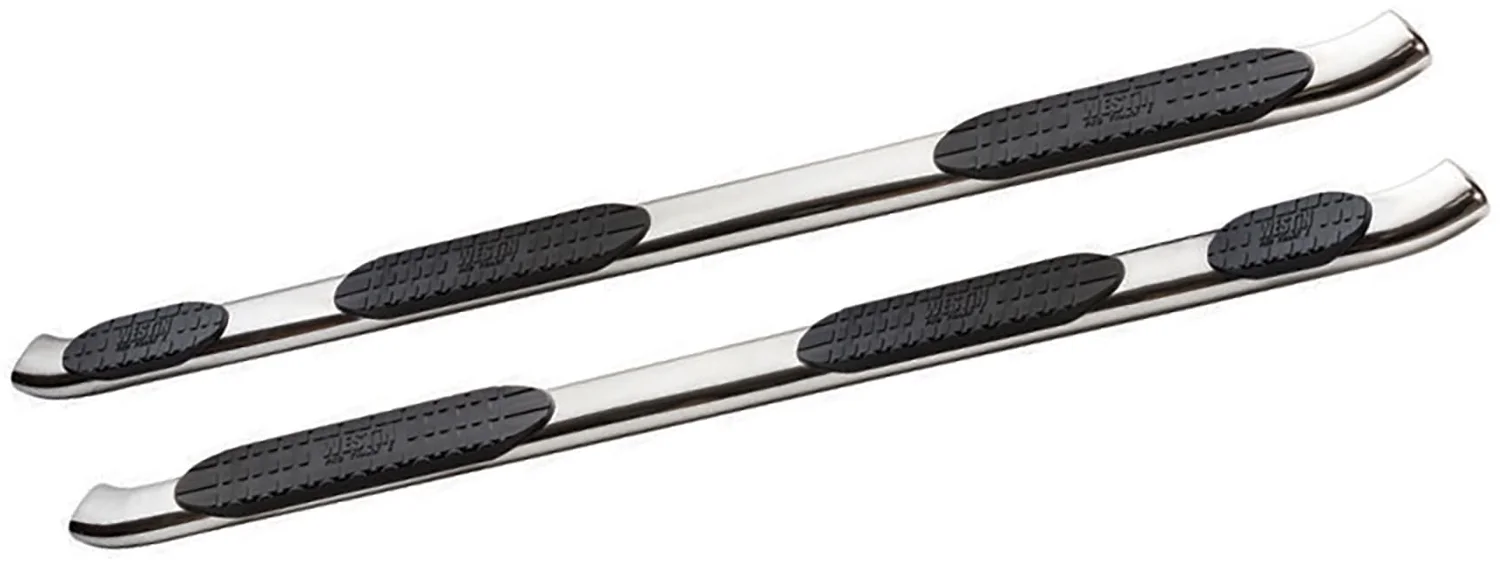
Every step that bolts under a truck's doors does the same basic job: give you, your kids and your passengers a solid place to step up into the cab. The differences are in shape, width, length and how far they hang down. A wide, flat running board is the easiest to stand on. A tubular nerf bar or side step is lighter and sportier. Drop steps and power boards help on lifted trucks where the floor is a long way up.
Most of what we sell comes from Go Rhino (RB10, RB20, RB30, Dominator, OE Xtreme, 1000 Series and the E1 electric board), Westin (R5, R7, SG6, Pro Traxx, HDX and E-Series), Dee Zee, Romik, Raptor, Big Country and Attica 4X4. This guide covers the styles, how to get the right fit for your cab, what to know about brackets, and how install usually goes.
The main styles compared
| Style | Shape | Step surface | Typical examples here | Best for |
|---|---|---|---|---|
| Running boards | Flat platform, roughly 4 to 7" wide | Full-length tread | Go Rhino RB10/RB20, Westin R5 and SG6, Romik, Raptor, Dee Zee NXT | Families, SUVs, the widest and easiest step |
| Nerf bars | Round tube, often 3 to 4" | Molded step pads at each door | Westin E-Series, Pro Traxx, Dee Zee 3" round | Lighter weight, classic truck look |
| Side steps (oval) | Oval or rectangular tube, 4 to 6" | Long pads or full tread | Go Rhino 1000 Series, OE Xtreme, Vertex, Dominator | A balance of step room and style |
| Drop steps | Bar with steps that hang lower | Step plates below the bar | Westin Outlaw Drop, HDX Drop, Go Rhino RB30 with 2X steps | Lifted or tall trucks |
| Power / electric boards | Board that deploys when a door opens | Full tread | Go Rhino E1 electric | Clean look and low step, highest cost |
| Rock sliders | Heavy steel, frame-mounted | Tube step on some models | Fishbone Offroad rock slider | Protecting rocker panels off-road |
A note on rock sliders: a slider is built to take the truck's weight when you drag a rocker over a rock, so it mounts to the frame. Most running boards and nerf bars are steps, not armor, and are not designed to carry the vehicle.
Getting the fit right: cab, bed and length
Steps are almost always made for a specific vehicle, and the details matter.
- Cab style. Regular cab, extended cab (SuperCab, Double Cab, Quad Cab, King Cab) and crew cab (SuperCrew, Crew Cab, CrewMax) each need a different length. Manufacturers do not all use the same names, so match your truck's exact cab name and door count.
- Cab length vs wheel-to-wheel. Cab-length steps end behind the rear door. Wheel-to-wheel steps run all the way to the rear tire, giving you a step to reach into the bed. Wheel-to-wheel versions are matched to bed length too (for example a 5.7, 6.5 or 8 foot bed).
- Model year and body generation. A redesign usually changes the mounting points. Check the year range on the listing.
- Universal boards. Some boards are sold by length (for example 48, 52, 73, 79 or 80 inches) for use with a vehicle-specific bracket kit. Measure and confirm both pieces fit together.
- Lift height. On a lifted truck, a standard board can sit high off the ground. Drop steps or an electric board bring the first step back down.
Check whether brackets are included. Many vehicle-specific kits include them, but some boards are listed "brackets sold separately", and we sell standalone mount kits from Westin, Dee Zee, Raptor and Gen-Y for that reason. If the listing does not clearly include brackets for your truck, plan on ordering them.
Materials, finish and step surface
- Aluminum (most running boards, like the Westin SG6 and Raptor OEM-style boards) is light and does not rust, but can scratch and dent.
- Stainless steel (polished Westin R5 and Go Rhino RB20 stainless) resists corrosion and keeps a bright finish with occasional cleaning.
- Mild steel with powder coat (many textured black side steps and Big Country Widesiders) is strong and affordable. Touch up chips so rust does not creep under the coating, especially if you live where roads are salted.
- Textured black hides scuffs well. Polished finishes look sharp but show wear.
For step surface, look for full-length rubber or grit treads if you have kids or step up in mud and snow. Molded pads on nerf bars give you grip only where the pads are. Weight capacity varies by product, so check the manufacturer's rating if you plan to stand on the boards to reach a roof rack.
Width and position matter as much as material. A 5 or 6 inch wide board or oval step gives most adults room for a whole foot, while 3 inch round nerf bars give you more of a ball-of-the-foot step. Boards that sit tight to the body (like Go Rhino's OE Xtreme low profile steps) keep a factory look and stay out of the way off-road, while boards that stick out further are easier to find with your foot but collect more mud and road spray onto your pants.
Install tips
Most vehicle-specific running boards and nerf bars bolt to existing holes in the rocker or cab mounts with hand tools, and many people install them in an hour or two. A few vehicles need drilling, and the instructions will say so.
- Clean and inspect the mounting holes. Rust or debris in captured nuts can make bolts hard to start.
- Leave all bolts loose until the board is aligned along its length, then torque to the listed spec.
- Check that the step does not block the door from opening fully, especially on drop steps.
- Electric running boards like the Go Rhino E1 involve wiring, sensors and motors. Allow more time, or have them professionally installed.
- Recheck bolts after a few hundred miles, and again after off-road trips.
- Rinse salt and mud out of brackets and step channels through the winter. Trapped grit is what wears through powder coat first.
Getting a truck ready for bigger tires too? See our lift and leveling kit guide. For more truck protection, see grille guards and bumpers.