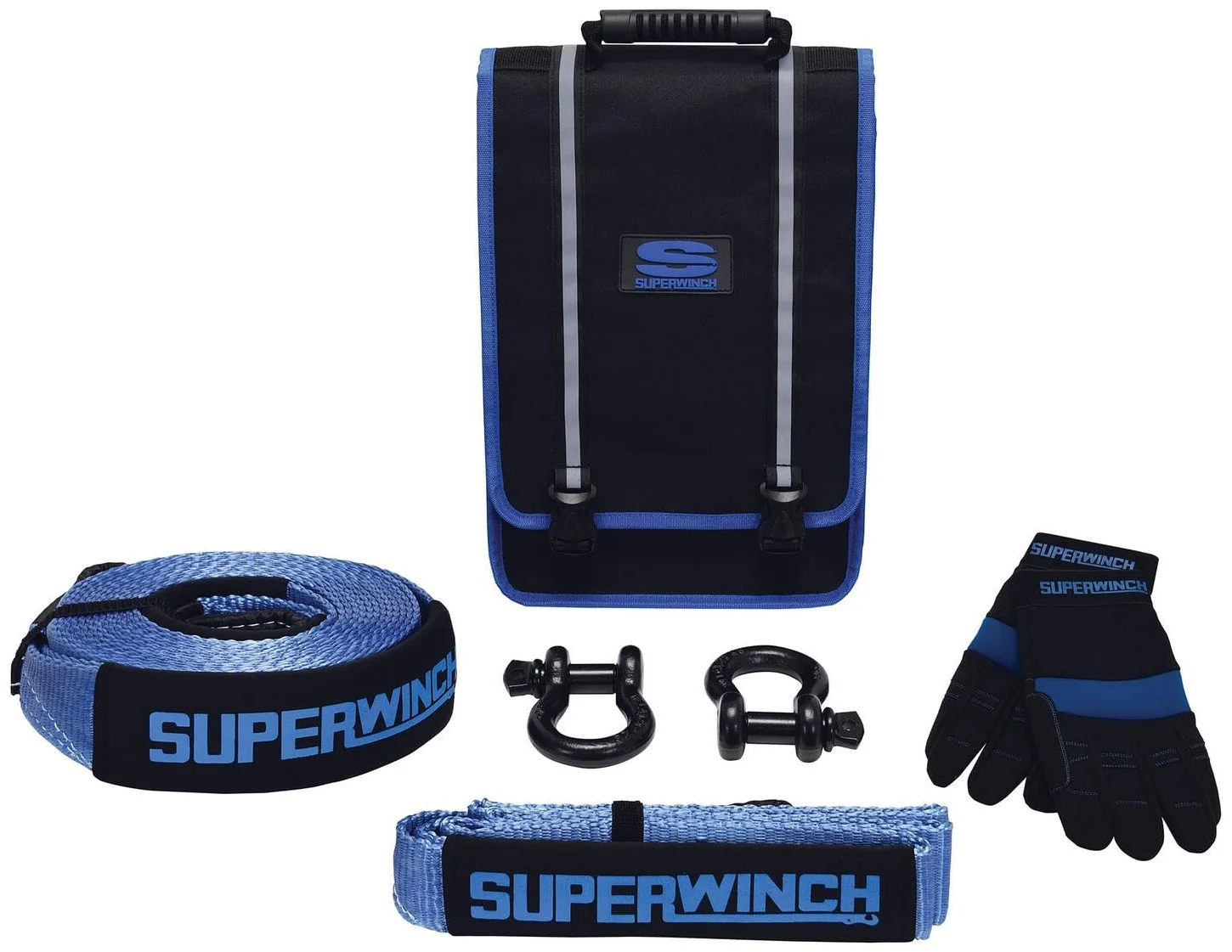
Everybody who wheels gets stuck eventually. The difference between a five-minute recovery and a broken vehicle (or a trip to the ER) is usually the gear you packed and how you used it. A good kit lets you get yourself out with traction boards and a jack, get pulled out with a kinetic rope or recovery strap, and connect everything safely with rated shackles and recovery points.
We stock kinetic recovery ropes from Bubba Rope, Erickson and Overland Vehicle Systems, recovery straps from Warn, Bulldog Winch, Hi-Lift and Smartstraps, traction boards from ARB (TRED Pro), Ironman 4x4, Tyger, TFX Overland, Caliber Xtrax and Extreme Max, soft shackles and snatch blocks, tire deflators, and the full line of Hi-Lift jacks and mounts. Here's what each piece does and how to choose it.
Kinetic ropes vs recovery straps vs tow straps
These look alike but behave very differently, and using the wrong one is one of the most common recovery mistakes.
| Type | Stretch | Use it for | Don't use it for |
|---|---|---|---|
| Kinetic recovery rope (Bubba Rope, Erickson, OVS Brute) | High; nylon stretches and stores energy | Snatch recoveries where the recovery vehicle gets a rolling start to pop a stuck rig free | Towing down the road |
| Snatch / recovery strap rated for kinetic use | Moderate (nylon) | Lighter snatch recoveries | Anything if it has metal hooks |
| Tow strap (often polyester) | Low | Steady pulls and flat towing at low speed | Jerking or snatch recoveries |
How strong? A common guideline is a strap or rope with a minimum breaking strength of roughly 2 to 3 times the stuck vehicle's weight. Too weak and it can snap; far too strong and it won't stretch enough to work as a kinetic rope. A loaded Jeep or half-ton (roughly 5,000 to 7,500 lb) points to something in the 15,000 to 22,000 lb range; heavy diesel trucks call for the bigger 1-1/4" and 1-1/2" ropes. Check the rating label on the product.
Never use a strap with metal hooks for recovery. If a hook or the point it's attached to fails, it becomes a projectile. Use loop-end straps (like the Hi-Lift, TowSmart and Smartstraps loop-end models) and connect them with a rated shackle or soft shackle. Hooked tow straps are for light, steady towing only.
Recovery points, shackles and snatch blocks
A strap is only as strong as what it's attached to.
- Use rated recovery points bolted to the frame: factory recovery hooks rated for it, aftermarket bumper shackle mounts, or a receiver shackle mount (Bulldog 3/4" shackle receiver mount, OVS aluminum soft shackle receiver mount). Never strap to a hitch ball, tie-down loops, suspension or axle parts; they aren't designed for recovery loads.
- Soft shackles (Superwinch, Bulldog) are lighter than steel and far less dangerous if something lets go. Steel bow shackles are durable and handle abrasion better. Use only shackles with a stated working load limit or breaking strength above the job.
- Snatch blocks (Bulldog 19K HD) redirect a winch line around a corner or double it back for roughly twice the pull. A recovery ring does similar work with soft shackles.
- Tree savers protect trees and give you a proper anchor point for winching.
Complete kits are an easy start: the Superwinch Getaway Vehicle Recovery Kit and Bulldog's 16,000 lb WLL rigging kit bundle rated straps and hardware. If you run a winch, see our truck winch guide.
Recovery safety basics: one person in charge, clear signals, spectators back at least 1.5 times the length of the strap or rope, and a damper or recovery blanket over the line. Inspect gear after every use and retire anything cut, burned, frayed or heavily abraded.
Self-recovery: traction boards, jacks and air down
Traction boards are the first thing to try when you're stuck alone in sand, mud or snow. Dig out in front of the tires, wedge the boards under the drive tires, and use low, steady throttle. Spinning tires on boards can melt the cleats. Options we stock:
| Board | Notes |
|---|---|
| ARB / Old Man Emu TRED Pro | Premium flexible boards with aggressive teeth |
| Ironman 4x4 Reco-Traks, Caliber Xtrax, TFX Overland | Full-size boards; many double as a short shovel |
| Tyger Topo Extra Wide | Wider footprint for big tires |
| Extreme Max 27" compact | Shorter, easier to store; good for smaller rigs and UTVs |
Mount them on a bed rack or roof rack with a proper bracket (Road Armor, Fabtech) so they're easy to reach. See our truck bed rack guide for mounting options.
Hi-Lift jacks (the 42" and 60" cast and steel, all-cast, Patriot and Stealth models) can lift a high-clearance vehicle for stacking rocks under a tire, clamp and pull with the Off-Road Recovery Kit, or pop a bead. They are also dangerous when misused: they need solid steel jacking points such as rock sliders or a steel bumper, an Off-Road Base on soft ground, and you should never get under a vehicle supported only by one. Keep the handle clipped up when not in use and the mechanism clean (a cover or bag helps). Hood, roll cage, bumper and Trail Trak mounts keep the jack secured instead of loose in the cab.
Air down. Lowering tire pressure lengthens the footprint and is often the cheapest fix for sand and soft trails. Tire deflators (Bulldog automatic brass, OVS adjustable) make it quick, and you'll need a compressor such as the Bulldog onboard air system or OVS Quick Flate to air back up before pavement. Right pressure depends on the tire and load; see what over and underinflation do to tires.
A sensible recovery kit, by trip type
- Trail starter (every off-road trip): loop-end recovery strap or kinetic rope sized to your vehicle, two rated shackles or soft shackles, a receiver shackle mount if you lack front and rear recovery points, gloves, a tire deflator set and a way to air up.
- Solo or remote travel: add a pair of traction boards, a shovel, a Hi-Lift or other jack with a base, and a tree saver.
- Winch-equipped rigs: add a snatch block, extra soft shackles, a line damper and a winch extension strap.
Store soft goods in a bag out of the sun, since UV and heat weaken nylon and polyester over time. Tires matter too: a good all-terrain or mud-terrain tire keeps you from getting stuck in the first place. Compare them in all-season vs all-terrain vs mud-terrain.