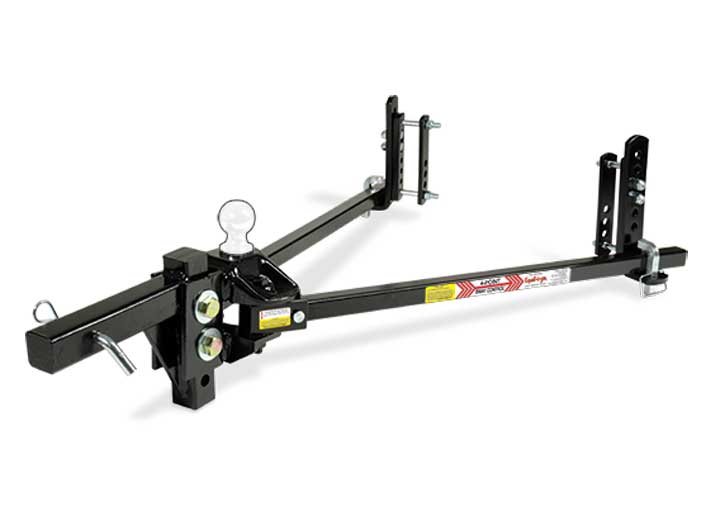


Hook a heavy travel trailer to a bare ball mount and the tongue weight pushes the rear of the tow vehicle down and levers the front end up. The rear sags, the headlights point at the sky, and the front tires lose some of the grip you need for steering and braking. A weight distribution (WD) hitch uses spring bars under tension to spread that tongue weight forward to the front axle and back to the trailer axles, so the whole rig rides closer to level.
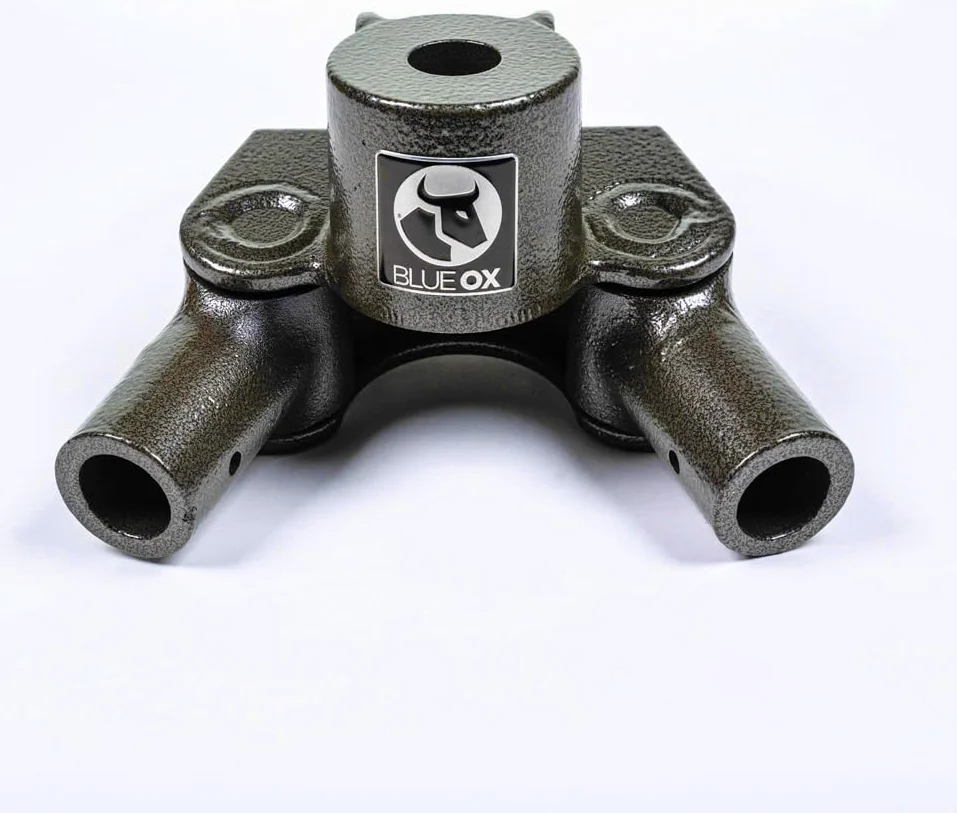
Most WD hitches also include sway control, which resists the trailer swinging side to side in crosswinds or when a semi passes. The kits we stock come from Equalizer and Fastway (the 4-point Equal-i-zer and E2 lines), Camco Eaz-Lift, Blue Ox TrackPro, Draw-Tite and RV Pro, plus the shanks, spring arms, pins and levers to service them. This guide covers the decisions that matter: when you need one, how to size it, which bar and sway style fits your trailer, and how to set it up.
Do you need a weight distribution hitch?
If you tow a travel trailer or any tall, heavy bumper-pull trailer, the answer is usually yes. Signs you need one:
- The rear of the tow vehicle drops noticeably when you hitch up, or the front end feels light and floaty.
- The trailer is near or over about half of your vehicle's tow rating, or it's a long camper that catches wind.
- Your hitch label or owner's manual requires it. Many Class III and IV receivers carry two ratings: a lower one for weight-carrying (plain ball mount) and a higher one with weight distribution. Many vehicle makers call for WD somewhere around 5,000 lb of trailer or 500 lb of tongue weight, but the exact threshold varies, so read your label and manual.
A WD hitch does not raise your vehicle's tow rating, payload or rear axle rating. It redistributes load; it doesn't remove it. Some vehicles (certain models with air or self-leveling suspension, and some unibody SUVs) have specific instructions or limits on WD use, so check the owner's manual before you buy. It's also worth confirming the hitch is compatible with your trailer's brakes, since some setups are not recommended with surge brakes. For more on receiver ratings, see our trailer hitch class guide.
How to size it: tongue weight first
WD hitches are rated two ways: gross trailer weight (GTW) and tongue weight (TW). Tongue weight is the number that actually sizes the spring bars. A properly loaded trailer puts about 10 to 15% of its loaded weight on the ball, so a 7,000 lb camper usually lands around 700 to 1,050 lb.
- Weigh, don't guess. Use a tongue scale or a CAT scale with the trailer loaded the way you travel (water, propane, batteries, gear). Brochure dry weights are always low.
- Add what's behind the rear axle. Bikes on the bumper, a loaded bed and passengers all affect how the hitch has to work. Manufacturers differ on how to account for this, so follow the sizing chart in the instructions.
- Pick a rating that brackets your real tongue weight. Bars that are far too stiff for a light tongue give a harsh, jarring ride; bars too light can't level the rig. Buying the biggest kit is not automatically better.
- Match the receiver and drop. Shanks come for 2" or 2-1/2" receivers and in different drop and rise heights. Measure from the ground to the top of your receiver opening and to the bottom of the trailer coupler (trailer level) to pick the drop. Adjustable shanks cover a wider range if you're unsure or tow more than one trailer.
| Loaded trailer weight | Approx. tongue weight (10-15%) | Look for a WD rating of |
|---|---|---|
| 4,000 lb | 400 to 600 lb | About 600 lb TW (e.g. 6K class) |
| 6,000 lb | 600 to 900 lb | About 800 to 1,000 lb TW |
| 8,000 lb | 800 to 1,200 lb | About 1,000 to 1,200 lb TW |
| 10,000 lb+ | 1,000 to 1,500 lb | About 1,200 to 1,400 lb TW (12K to 14K kits) |
Treat the table as a starting point. Your measured tongue weight and the manufacturer's chart are the final word, and every link in the chain (vehicle, receiver, shank, ball, coupler) has to be rated for the load. Our tow ball guide covers the ball side.
Round bar vs trunnion, and the sway control styles
Two choices define most WD hitches: how the spring bars attach to the head, and how the system fights sway.
| Style | How it works | Good for | Examples in stock |
|---|---|---|---|
| Round bar | Bars insert up into the bottom of the head | Lighter trailers, budget setups | Equalizer / Fastway E2 Round Bar 8K and 10K |
| Trunnion bar | Square bars slide into the side of the head | More ground clearance, heavier tongues | E2 Trunnion 4.5K to 12K, Camco Eaz-Lift TR3 and Trunnion 1,200 lb |
| 4-point integrated sway | Sway resistance built into the head and bar brackets | Long travel trailers, windy routes | Equalizer / Fastway 4-Point 10K, 12K, 14K, 16K |
| Add-on friction sway | Separate friction bar between trailer and ball mount | Adding sway control to a basic kit | Camco Eaz-Lift Elite kits, sway adapter plates |
| Cam or track sway | Cams or a track system keep the trailer centered | Drivers who want strong centering | Draw-Tite Dual Cam HP, Blue Ox TrackPro |
Which is best? For most campers, a 4-point integrated system like the Equalizer is the simplest to live with because sway control comes built in and there's no separate friction bar to set every trip. Round bar and trunnion E2 kits are a solid value for lighter or shorter trailers. If your trailer is long, tall or prone to sway, put more weight on the sway control design than on price.
Remember that no hitch fixes a badly loaded trailer. If tongue weight drops below about 10% (heavy gear behind the trailer axles, empty front tanks), sway gets worse no matter what hitch you run.
Setup, maintenance and parts
A WD hitch only works if it's set up for your specific truck and trailer. The general process:
- Measure first. With the truck unhitched on level ground, measure from the ground to the top of the front and rear wheel openings.
- Set ball height and head tilt. Choose the shank hole so the trailer sits level or slightly nose down, then set the head angle with the washers or adjustment bolts the kit uses.
- Hitch up and tension the bars. Measure again. Tension the spring bars until the front fender height comes back toward its unhitched number. Each manufacturer gives its own target, so use the one in your instructions.
- Torque everything and test drive. Recheck torque after the first trip and periodically after that.
Keep it working. Grease the ball and any sliding contact points the manual calls for (some friction sway surfaces must stay dry), inspect pins, clips and lift brackets for wear, and never tow with a missing pin. We stock replacement spring arms (pairs), shanks in 2" and 2-1/2" with drops from about 1-5/8" to 12", heads, snap-up levers, L-pins, socket pins, bolt kits and the Camco hook-up handle. A Morryde removable storage bracket keeps a heavy head and shank off the truck bed floor between trips.
If your truck still sags with the bars set correctly, the problem is usually payload or rear springs, not the hitch. Overloaded rear tires are a related risk; see tire load index explained.