Most dock damage happens slowly: a line that is too thin chafes through, a fender that is too small lets the hull grind on a piling, a cleat screwed into thin fiberglass pulls out in the first big wake. The fix is not expensive gear, it is correctly sized gear. This guide gives you the common rules of thumb for each piece so you can buy once.
We cover dock lines and anchor rope, fenders and dock bumpers, cleats and dock hardware, and propellers, since a dinged prop is one of the most common things boaters replace each season. Brands we carry include Attwood, Sea Dog, T-H Marine and CMP for lines and hardware, Polyform for fenders, Solidify Manufacturing for dock wheels, and Turning Point for aluminum and stainless propellers.
Dock lines and anchor rope
Material: nylon is the standard for dock and anchor lines because it stretches under load. That stretch absorbs the shock of wakes and gusts instead of passing it to your cleats. Polyester stretches less and is better for running rigging, not mooring.
Construction:
- Double braid (a braided core inside a braided cover), like the Attwood, T-H Marine, CMP and Sea Dog double braid lines, is soft on the hands, strong for its size and resists kinking. It is the most popular choice for dock lines.
- Three-strand twisted nylon, like the Sea Dog twisted dock and anchor lines, stretches more, costs less and is easy to splice. It is a traditional choice for anchor rode.
Diameter: a common rule of thumb is about 1/8 inch of line diameter for every 9 feet of boat length, then size up if the boat is heavy for its length or the dock is exposed to weather.
| Boat length (approx.) | Typical dock line diameter |
|---|---|
| Up to about 27 ft | 3/8 inch |
| About 27 to 35 ft | 1/2 inch |
| About 35 to 45 ft | 5/8 inch |
Length: bow and stern lines are often about two-thirds of the boat's length, and spring lines (which stop the boat surging forward and back) are often about the full boat length. Many owners keep a mix of 15, 20 and 25 foot lines so they can tie up at docks with cleats in odd places. Lines with a spliced eye on one end drop over a cleat or piling quickly.
Anchor rode: the line between the anchor and the boat needs to be long enough to give a good angle of pull. A common guideline is a scope of about 5:1 to 7:1 (rode length to water depth plus bow height) for anchoring in typical conditions, with more in rough weather. A 150 foot rode like the Sea Dog 3/8 inch twisted nylon line covers moderate depths for many small boats. A short length of chain between anchor and rope helps the anchor set and resists chafe on the bottom.
Sizing boat fenders and dock bumpers
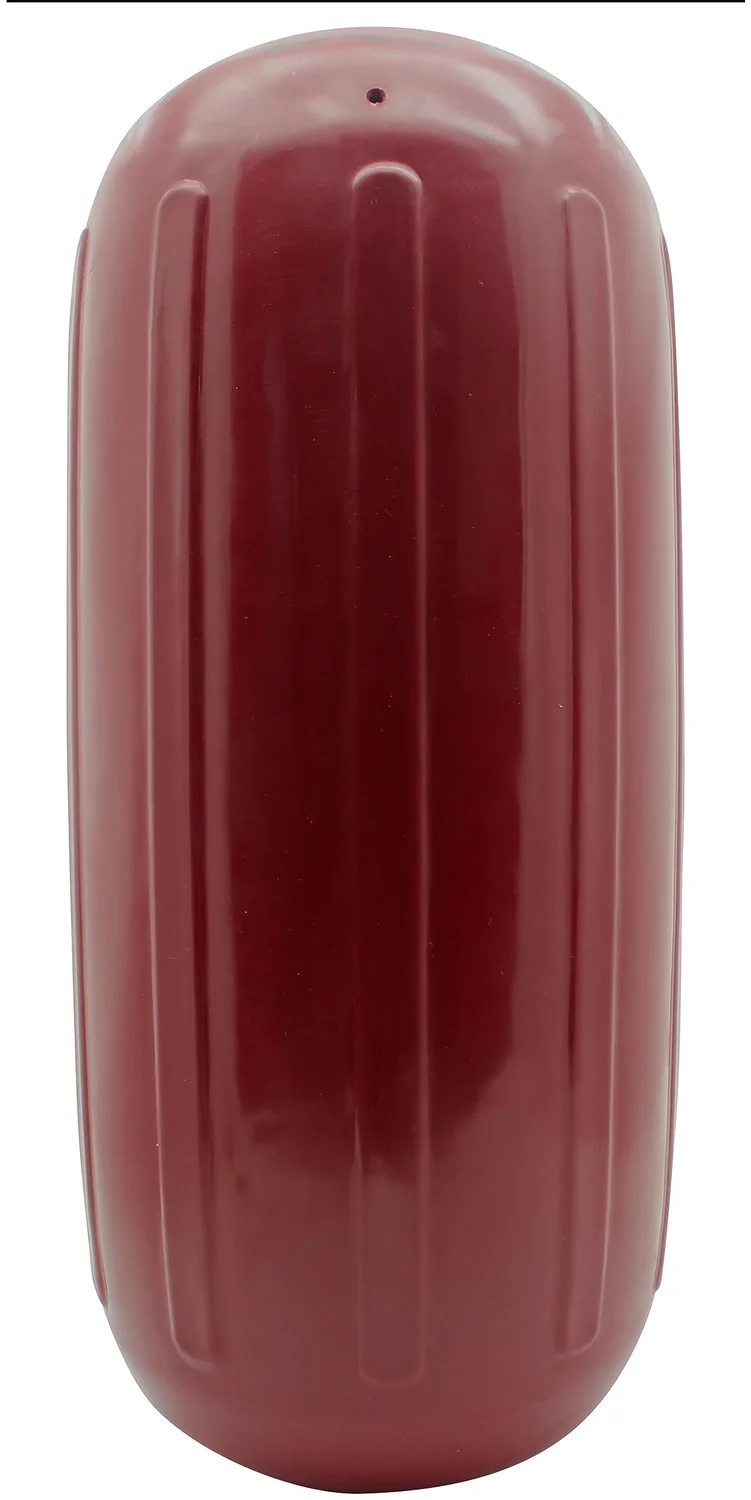
Fenders protect the hull from the dock, pilings and other boats. A frequently quoted guideline is about 1 inch of fender diameter for every 4 to 5 feet of boat length, with at least three fenders on the side you tie up, and roughly one fender per 10 feet of waterline after that. Size up for heavier boats, rough water or concrete docks.
| Type | How it hangs | Best use |
|---|---|---|
| Twin eye (Polyform G series) | Line attaches at either end, so it can hang vertically or horizontally | General docking; horizontal against pilings |
| Center tube (Polyform F series) | Line runs through the middle, often with a knot at the bottom | Larger cylindrical fenders that hang straight and stay put |
| Dock bumpers | Fixed to the dock edge or post | Permanent padding at your own slip, like the Greenfield Dock Buddy |
Hang fenders so the widest part of the hull meets them, and adjust the height to match the dock or piling. Tie them with a clove hitch or a fender adjuster to the rail or a cleat, not to a stanchion base that can bend. Inflatable vinyl fenders such as Polyform's can usually be topped up with air if they lose firmness; check the maker's recommended pressure.
Small fenders like the Polyform G-1 suit dinghies, PWCs and small runabouts. Larger ones like the G-4, the commercial grade G series and the F-5 suit cruisers and boats that sit at a dock for long stretches.
Cleats, dock wheels and dock hardware
Cleat size: a widely used rule is 1 inch of cleat length for every 1/16 inch of line diameter. So 3/8 inch line suits a cleat around 6 inches long, and 1/2 inch line wants about 8 inches. An undersized cleat will not hold enough turns to secure the line properly.
- Hollow base and open base cleats, like the Attwood 5 inch stainless hollow base cleat and the Sea Dog open base cleat, let a line or spliced eye pass through or under the base, which is handy for permanent dock lines.
- Stud mount cleats have threaded studs that through-bolt from below. Through-bolting with a backing plate is the strongest installation. Screws alone into thin fiberglass or soft wood are not recommended for mooring loads.
- Material: stainless steel resists corrosion best in salt water. Chrome-plated zinc and other plated cleats cost less and are common in fresh water.
Dock wheels like the Solidify Manufacturing 24 inch, 800 lb capacity wheel let roll-in docks and lifts be moved in and out of the water each season. Check the rated capacity per wheel against the weight it will carry, and match the axle and mounting to your dock frame.
Ladders and lifts: boat and dock ladders are sized by the number of steps and how far they need to reach below the waterline; pick one rated for the weight of the heaviest person who will use it. If your boat lives on a lift, our boat lift motors guide covers powering it, and the boat trailer parts guide covers rollers, bunks and winches for trailer boats.
Choosing a replacement propeller
Propellers are listed by diameter x pitch, so a 14.25x17 prop is 14.25 inches across with 17 inches of pitch (the distance it would move forward in one turn with no slip). To replace a damaged prop, start with the size stamped on your current one.
- Pitch and RPM: pitch is the main tuning tool. Many props follow a rough rule that each inch of pitch changes wide open throttle RPM by around 150 to 200 RPM. Lower pitch raises RPM and helps acceleration and heavy loads; higher pitch lowers RPM and can raise top speed. Your engine should reach its maker's recommended wide open throttle RPM range with a normal load.
- Rotation: RH (right hand) props are standard on most single outboards. LH (left hand) props are for counter-rotating engines on twin setups. Ordering the wrong rotation is a common mistake.
- Aluminum vs stainless: aluminum props like the Turning Point Hustler are inexpensive and will often bend before transferring a hard strike to the lower unit. Stainless props like the Turning Point Express Mach3 and Mach4 are stronger, flex less and often perform better, at a higher price.
- Blade count: three blades is the common all-rounder. Four blades, as on the Mach4, often improve hole shot, grip in turns and handling in rough water, sometimes with a little less top speed.
- Hub kits: many aftermarket props use an interchangeable hub to fit different engine shafts. Confirm the hub kit (such as the Turning Point MasterGuard hub kits) matches your engine's make, horsepower and spline.
Always check the prop fits your engine before ordering, keep a prop wrench like the T-H Marine Prop Master on board, and carry a spare if you run in shallow or rocky water.