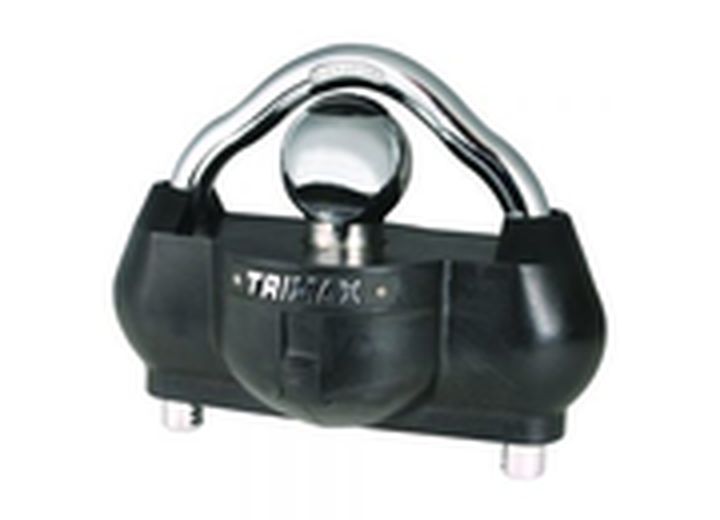
The receiver hitch bolted to your vehicle is only half the connection. Between it and the trailer sit three small parts that do a lot of work: the ball mount that slides into the receiver, the hitch ball that the trailer coupler latches onto, and the pin or lock that holds it all together. Get one of them wrong and the whole setup is only as strong as the weakest piece.
We carry hitch balls from Tow-Rite, Draw-Tite, Camco and Fastway/Equal-I-Zer, ball mounts from Draw-Tite, Towsmart and Fastway, and a deep selection of receiver locks, coupler locks and hitch pins from Trimax, Master Lock, C.T. Johnson, Weigh Safe, Strattec, Swagman, Infiniterule and others. This guide covers the decisions that matter: ball size and shank fit, mount drop and rating, and choosing locks that actually fit your hitch.
Choosing the hitch ball
A hitch ball has four specs that matter: ball diameter, shank diameter, shank length and weight rating. Most balls have the size and rating stamped on top.
| Ball size | Typical use | Typical rating range |
|---|---|---|
| 1-7/8 inch | Small utility trailers, jet skis, light boats | Often around 2,000 lb |
| 2 inch | Most utility, boat and camper trailers | Commonly 3,500 to 8,000 lb or more |
| 2-5/16 inch | Heavy campers, car haulers, equipment | Commonly 6,000 lb up to 20,000 lb or more |
Ratings vary a lot within each size, so check the stamp rather than assuming. Our Tow-Rite 2 inch balls come in 3,500 lb and 5,000 lb versions, for example, while the Draw-Tite chrome 2-5/16 inch ball is rated at 12,000 lb.
- Match the coupler. The ball diameter must match the size stamped on the trailer coupler. A 2 inch ball in a 2-5/16 inch coupler can pop off on a bump.
- Match the shank to the mount hole. Common shank diameters are 3/4, 1 and 1-1/4 inch. The shank should fit the hole snugly; if the hole is larger, use a reducer bushing made for the purpose.
- Check shank length. The threads must pass fully through the mount with room for the lock washer and nut. Thick solid-steel mounts need longer shanks.
- Torque the nut. Tighten to the ball maker's specification and recheck it periodically.
Our tow ball size guide goes deeper on matching balls to trailers.
Choosing the ball mount: drop, rise and rating
The ball mount sets the height of the ball. The goal is a trailer that sits level, or very slightly nose down, when hitched. A nose-high trailer can reduce tongue weight and make sway more likely; a nose-low one overloads the front axle of the trailer and drags the tongue jack on driveways.
- Park the trailer on level ground and level it with the tongue jack.
- Measure from the ground to the bottom of the coupler.
- Measure from the ground to the top of the inside of your receiver opening.
- Receiver height minus coupler height is the drop you need. If the coupler is higher, flip the mount to use it as a rise, if the mount design allows.
Lifted pickups often need 6 to 10 inches of drop. We stock Draw-Tite Class III and Class IV mounts with a 6 inch drop and the Fastway FLASH solid-steel mount with a 10 inch drop and two balls included.
Rating and fit. The ball mount must fit your receiver size (1-1/4 inch for most Class I and II, 2 inch for Class III and many Class IV, larger for heavy-duty receivers) and carry a rating at or above your trailer weight and tongue weight. Your setup is rated only as high as its lowest-rated part: the vehicle, receiver, ball mount, ball, coupler and safety chains. Check the hitch label and your owner's manual, and see our trailer hitch class guide if you're still choosing a receiver. Draw-Tite Class I and II receivers for cars and crossovers are sold without a ball mount, so plan to add one.
For heavier campers, a regular ball mount may not be enough. If your trailer squats the truck, a weight distribution hitch replaces the plain ball mount with a shank and spring bars.
Receiver locks, coupler locks and hitch pins
Ball mounts, bike racks and even entire trailers are easy to steal. Locks are cheap insurance, but only if they fit.
| Lock type | What it protects | How to size it |
|---|---|---|
| Receiver lock (bent pin, dogbone, straight pin) | Ball mount or rack in the receiver | Pin diameter and usable span |
| Coupler latch lock | Keeps the coupler latched on the ball while towing or parked hitched | Pin diameter and span of the latch hole |
| Universal or ball-style coupler lock | Stops someone hitching up to a parked trailer | Coupler size (1-7/8, 2 or 2-5/16 inch) |
| Adjustable mount pin locks | Pins on adjustable ball mounts like Gen-Y, B&W Tow and Stow and BulletProof | Brand and series of the mount |
Pin diameter follows the receiver: 1/2 inch is typical for 1-1/4 inch receivers, and 5/8 inch for most 2 inch and 2-1/2 inch receivers. Some heavy-duty 3 inch receivers use a larger pin, so measure the hole. Span is the usable length between the lock head and the lock body. Measure across the outside of your receiver; thick hitch boxes and anti-rattle devices can need a longer span.
Brands we carry cover each type: Trimax receiver and coupler locks (including the UMAX50 universal coupler lock and keyed-alike sets), Master Lock, C.T. Johnson and Bulldog receiver locks, Strattec locks keyed to Ford or GM keys, Weigh Safe locking pins, Swagman cable and hitch lock kits, and Infiniterule multi-packs made for specific adjustable ball mounts. Keyed-alike sets save juggling keys. A plain JR Products pin and clip or an RV Intelligence pin leash is fine when you only need to hold the mount in place.
Hook-up checklist and care
- Latch and pin the coupler. Close the latch fully over the ball and insert a pin or lock through it. Lift the tongue slightly with the jack to confirm the coupler is locked on.
- Cross the safety chains under the tongue so they can cradle it if the coupler lets go. Leave enough slack to turn, but keep them off the pavement.
- Connect the breakaway cable (if the trailer has brakes) and the lights. Our trailer wiring guide covers connectors and brake controllers.
- Grease the ball lightly to reduce wear, unless your sway control or coupler instructions say otherwise. Wipe it or cover it when unhitched.
- Inspect regularly. Replace a ball that's flattened, pitted or out of round, a mount with cracks or bent shanks, and any pin that's bent or worn.
- Remove the mount when you're not towing. A bare ball mount sticking out is a shin hazard and a theft target, and it can hurt more in a rear-end collision.
If you're towing near the limits of your vehicle, check tire load ratings too (tire load index explained), and see tow hitch classes explained for what each receiver can safely handle.