Every RV has two separate water systems, and the gear for each should never mix. The fresh water side brings drinking water in through a hose, a pressure regulator and usually a filter, or from the fresh tank through a 12V pump. The waste side holds gray water (sinks, shower) and black water (toilet) in holding tanks until you dump them through a sewer hose. Good gear on both sides makes hookups faster and cleaner and protects your plumbing.
We stock hoses, fittings and filters from Camco and Valterra, tank treatments from Walex, Propack, Camco and Valterra, replacement holding tanks from Icon, and fresh water pumps from Seaflo, Johnson Pump and Powermax.
Sewer hoses, fittings and supports
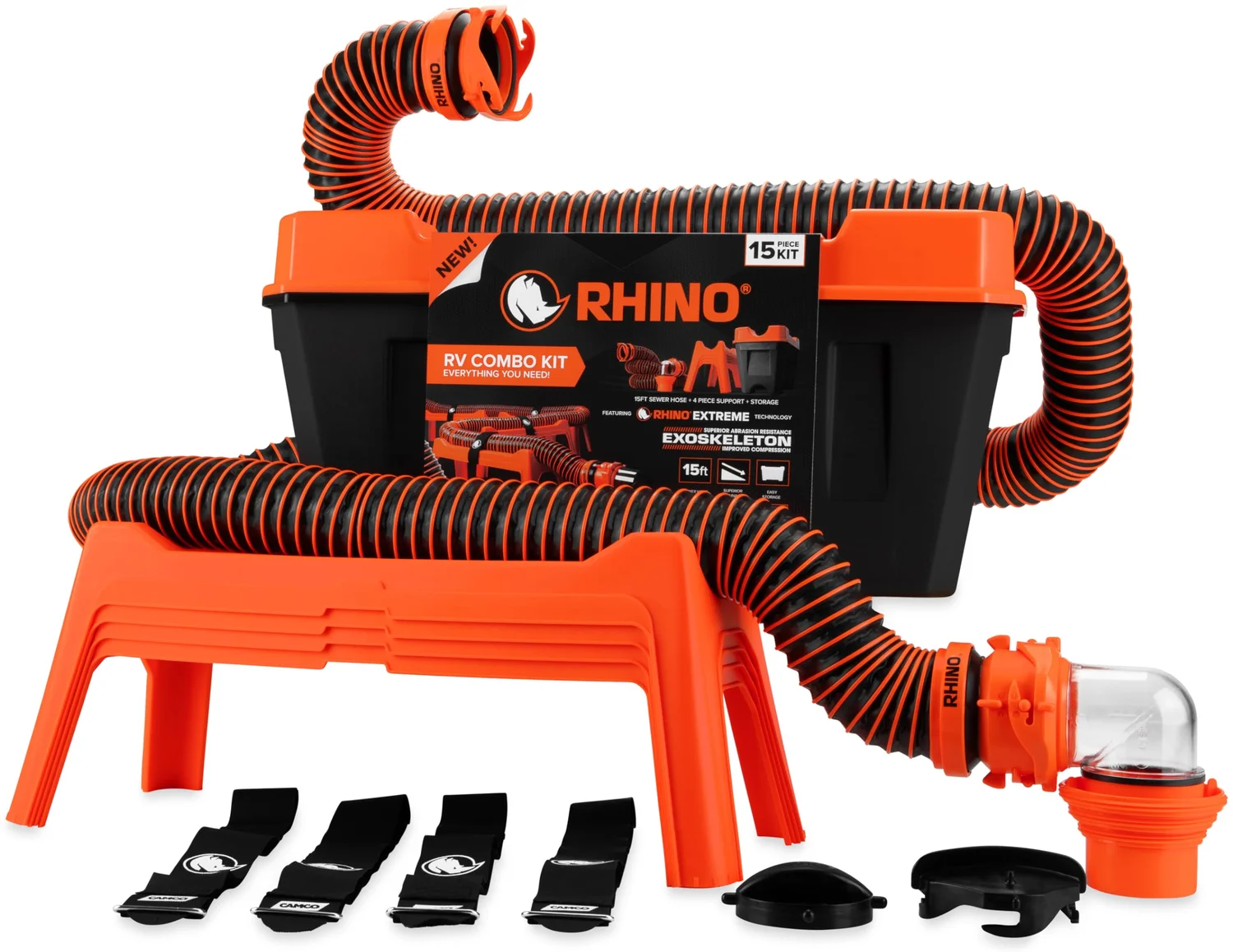
A basic sewer setup is a 3 inch sewer hose with bayonet fittings, an elbow or adapter for the dump inlet, and a way to keep the hose sloped downhill.
- Hose length: 15 to 20 feet covers most sites; carry an extension like the Valterra SewerSolution 15 ft extension hose, or a second hose, for long reaches.
- Elbows and adapters: a clear elbow or clear extender adapter (like Camco's 9 inch clear adapter) lets you see when the tank is running clean. The Camco RhinoFLEX elbow with 4-in-1 adapter fits several common threaded inlet sizes.
- Supports: a support like the Camco Sidewinder holds the hose in a steady downhill slope so waste does not sit in low spots.
- Storage: a dedicated hose storage hatch, like the B&B Molders hatch, keeps the hose out of your storage bays.
- Macerator pumps: a macerator grinds waste and pumps it through a smaller hose, which helps when the dump inlet is uphill or far away. Match the pump voltage to your system, since some models (like Johnson's 24V macerator) are aimed at marine use.
Dump the black tank first, then the gray tank, so the soapy gray water rinses the hose. Wear disposable gloves, keep a separate hose for rinsing, and dump only at approved dump stations or full-hookup sites.
Sewer hoses wear out. Sun, cold and dragging across gravel make the thin wall brittle, and a pinhole is a mess you only discover while dumping. Inspect the hose each trip, rinse it before storing, and replace it at the first crack. Heavier-wall hoses cost more but tend to last longer.
Fresh water hoses, regulators and filters
| Part | What it does | What to look for |
|---|---|---|
| Drinking water hose | Carries city water to the RV | Labeled safe for drinking water, typically 5/8 inch ID; 25 to 75 ft lengths |
| Heated hose | Keeps the supply line from freezing | Length to reach the spigot and a nearby outlet for power |
| Pressure regulator | Limits campground water pressure | Fixed or adjustable with a gauge; lead-free brass |
| Water filter | Reduces sediment, taste and odor | Inline cartridges or multi-stage canister systems; replacement cartridge cost |
- Hoses: use a hose made for drinking water, like the Camco TastePURE 75 ft hose, and never use it for flushing tanks. In freezing weather, a heated hose like Camco's 40 Series heated drinking water hose keeps water flowing.
- Regulators: campground water pressure can be high enough to damage RV plumbing and fittings. A regulator at the spigot protects the system; an adjustable model like the Valterra lead-free brass regulator lets you set the pressure and read it on a gauge. Many owners put the regulator right at the spigot so the hose and filter are protected too. Check your RV manual for the recommended pressure, often somewhere around 40 to 60 psi.
- Filters: inline filters like the Camco TastePURE are inexpensive and easy; multi-stage systems like the Camco EVO X2 and X3 add more filtration in a canister. Replace cartridges on the maker's schedule, and check each filter's stated ratings for what it does and does not remove.
Holding tank treatments and cleaners
Treatments control odor and help break down waste and toilet paper so tanks drain fully and sensors read correctly.
- Liquid treatments like Walex Bio-Fresh, Propack Kronen, Camco TST, Valterra T-5 and Valterra Pure Power Blue are dosed into the toilet after each dump.
- Drop-in packs like Walex Porta Pak are pre-measured and easy to store.
- Tank cleaners like Walex Commando black tank cleaner and Valterra Sensor Power help clear buildup that causes odors and false sensor readings.
Some treatments are enzyme or bacteria based and others use stronger chemicals. Some campgrounds and septic systems restrict certain chemicals, so check the label and the campground's rules. A few habits matter as much as the product:
- Use plenty of water when flushing, and add a few gallons to the black tank after dumping.
- Keep the black valve closed while hooked up, and dump when the tank is well filled so the flow carries solids out.
- Use toilet paper that breaks down quickly.
- If sensors read full when the tank is empty, residue on the tank walls is the usual cause. A cleaner and a good flush often fix it.
Pumps, tanks and repairs
When you are not on city water, a 12V fresh water pump pressurizes the system from the fresh tank. Replacement pumps are rated by flow (GPM) and pressure (PSI); match or slightly exceed the original pump's ratings, and confirm the port size and mounting. Examples we stock include the Seaflo 42 Series (3.0 GPM, 55 PSI), Powermax 3.2 GPM pumps in 12V and 115V, and the Johnson Pump FlowMaster variable speed pump. A pump that cycles on and off with the faucets closed usually points to a leak or a worn check valve.
For bigger repairs, replacement holding tanks from Icon come in many shapes and sizes, often with spigots and level sensors. Measure your old tank and its fitting locations carefully before ordering. A tank monitor panel like the Am.Tech K21 reads tank levels, and a patch kit like the Insta Holding Tank Patch Kit can seal small cracks.
Before freezing weather, drain the tanks and water lines and winterize according to your RV maker's instructions, using RV antifreeze rated for potable water systems. For the rest of the rig, see our RV awning guide and RV stabilizer and leveling jack guide.