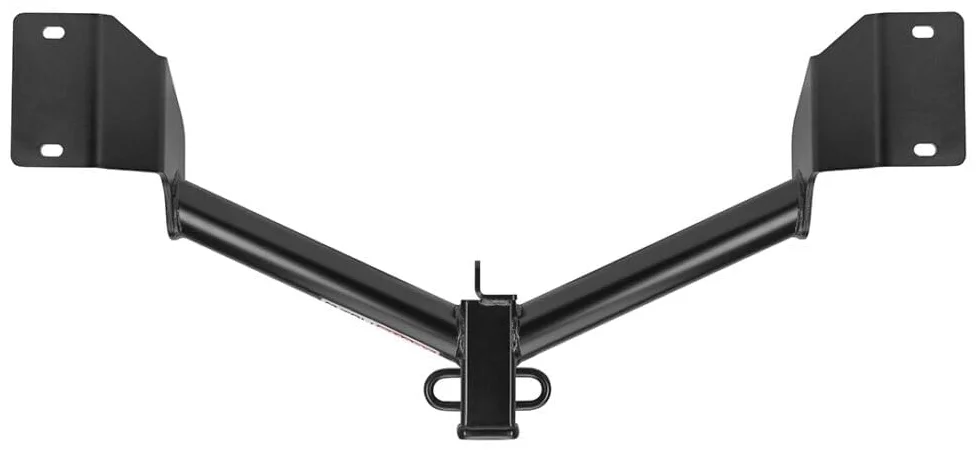
You need whatever size your hitch has, and you can measure the inside of the opening to find out. A 2 inch receiver is the standard on Class III and most Class IV hitches, typically rated up to about 10,000 lb. A 2-1/2 inch receiver is typically used on Class V hitches and many 3/4-ton and 1-ton trucks for heavier loads.
Receiver size alone does not set capacity. The lowest rated component sets the limit: vehicle, hitch, ball mount or shank, ball and coupler. Read the hitch label and the owner's manual.
Receiver sizes compared
| Receiver | Typical class | Typical capacity | Typical hitch pin | Common use |
|---|---|---|---|---|
| 1-1/4 inch | Class I, II | up to 2,000 / 3,500 lb | 1/2 inch | Cars, small crossovers, bike racks |
| 2 inch | Class III, IV | up to about 8,000 / 10,000 lb | 5/8 inch | SUVs, half-tons, most racks |
| 2-1/2 inch | Class V | higher, often 12,000 lb and up | typically 5/8 inch | Heavy-duty pickups |
| 3 inch | Class V commercial | higher still | varies | Commercial and very heavy towing |
Figures are typical. Your hitch's label is what counts.
Worked example: does a 2 inch receiver cover it
A 3/4-ton truck has a 2-1/2 inch receiver labeled 17,000 lb GTW / 1,700 lb TW weight-carrying. The owner wants to tow a 9,000 lb travel trailer and also use a 2 inch bike rack.
- Tongue weight: 9,000 x 0.10 = 900 lb to 9,000 x 0.15 = 1,350 lb.
- Towing: use a 2-1/2 inch ball mount or WD shank rated at least 9,000 lb and 1,350 lb TW. A 2 inch mount in a reducer sleeve is not the right choice here.
- Bike rack: a 2-1/2 to 2 inch reducer sleeve is fine for a light accessory, but the reducer's own rating, often well below the hitch, becomes the limit.
The reverse never works: you cannot adapt a 2 inch receiver up to a 2-1/2 inch shank to gain capacity.
Which one do you need
- Buying a ball mount or WD shank? Match it to your receiver opening exactly. Measure inside the tube.
- Buying a hitch? Hitches are vehicle-specific. If your truck is a heavy-duty model, the hitch made for it is often 2-1/2 inch. Lighter vehicles typically get 2 inch.
- Towing under about 10,000 lb on a half-ton or SUV? 2 inch is typical, if the vehicle and hitch are rated for the load. See Class 3 vs Class 4.
- Towing heavier on a 3/4 or 1-ton? A 2-1/2 inch Class V receiver is common, often with weight distribution for big travel trailers.
How to measure and confirm your receiver
The easiest way to confirm your receiver size is with a tape measure. Measure across the inside of the opening, wall to wall. A 1-1/4 inch receiver measures about 1-1/4 inches, a 2 inch about 2 inches, and a 2-1/2 inch about 2-1/2 inches. Measure the inside, not the outside, since the outside includes the steel wall.
You can also check:
- The hitch label: most hitches carry a sticker or stamp with the class, receiver size and ratings. Clean it off and read it before you buy a ball mount.
- The pin hole: a 1/2 inch hole typically means a 1-1/4 inch receiver. A 5/8 inch hole is typical for 2 and 2-1/2 inch receivers, so the pin alone will not tell those two apart.
- The owner's manual: factory hitches on many trucks are described in the towing section.
Some heavy-duty trucks come with a 2-1/2 inch receiver and a factory 2 inch reducer sleeve already installed. If you see an inner tube inside the receiver, that is what you are looking at. Remove the sleeve to use full-size 2-1/2 inch shanks and mounts. Leave it in only for light accessories, and keep in mind the sleeve has its own rating.
Once you know the size, order the ball mount, WD shank or accessory to match it exactly, and check that its rating covers your loaded trailer weight and tongue weight. A mount that fits the receiver but carries a lower rating than your trailer still sets the limit for the whole setup.
Common mistakes
- Running a 2 inch mount in a reducer for heavy towing. The sleeve and the smaller shank limit capacity, and the extra joint adds play.
- Wrong pin size. Use the pin size the receiver calls for, typically 5/8 inch for both 2 and 2-1/2 inch.
- Assuming a bigger receiver means more capacity on your vehicle. The vehicle rating still applies. See how much can my truck tow.