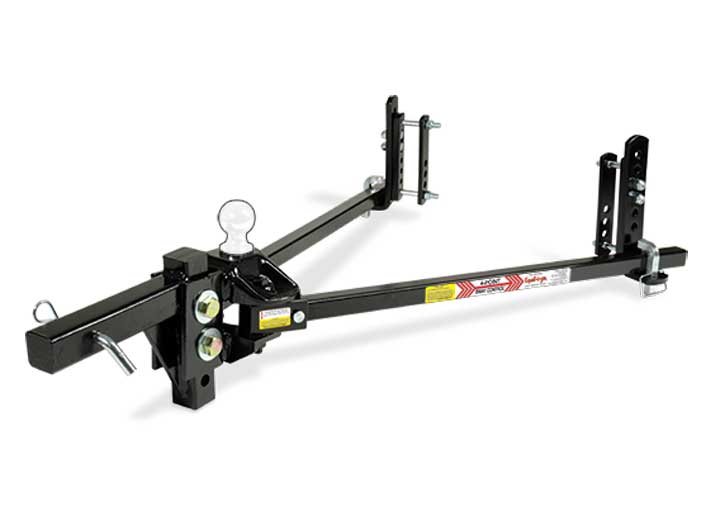


To estimate tongue weight, multiply your loaded trailer weight by 0.10 and 0.15. A conventional ball-hitch trailer typically carries 10 to 15% of its weight on the ball, so a 5,000 lb trailer has roughly 500 to 750 lb of tongue weight. Fifth-wheel and gooseneck trailers run higher, typically 15 to 25%.
The estimate tells you what hitch to shop for, but loading changes the real number, so measure it. Your setup is limited by the lowest rated component: vehicle, hitch, ball mount, ball and coupler. Check the owner's manual and every label.
Worked examples at 3,000, 5,000 and 8,000 lb
| Loaded trailer | 10% | 12% | 15% | Typical hitch class |
|---|---|---|---|---|
| 3,000 lb | 300 lb | 360 lb | 450 lb | Class III (Class II tops out at 3,500 / 350) |
| 5,000 lb | 500 lb | 600 lb | 750 lb | Class III |
| 8,000 lb | 800 lb | 960 lb | 1,200 lb | Class IV or V, often with WD |
Example: a 3,000 lb boat and trailer. 3,000 x 0.10 = 300 lb and 3,000 x 0.15 = 450 lb. A Class II hitch is rated around 3,500 lb GTW but only 350 lb TW, so at anything above about 11.7% tongue weight, the Class II is overloaded. That is why many 3,000 lb trailers end up on a Class III.
Example: an 8,000 lb travel trailer. 8,000 x 0.12 = 960 lb. A typical Class III (about 800 lb TW) is out. A typical Class IV (about 1,000 lb TW) is close to its limit at 12%, which is why weight distribution and a hitch with a higher WD rating are common here.
How to measure tongue weight with a bathroom scale
Up to about 300 lb: set the scale on a sturdy box or block so the coupler sits at its normal towing height, lower the coupler onto the scale (protect it with a board), and read the number. The trailer should be level and loaded as you tow it.
Heavier tongues (the lever method): most bathroom scales top out around 300 to 400 lb, so use a beam to divide the load.
- Place a short length of pipe on the scale and another on a brick or block of the same height, 3 feet apart.
- Lay a sturdy beam, such as a 4x4, across both pipes. Zero the scale, or note the reading so you can subtract it.
- Lower the coupler onto the beam with a jack stand or block, 1 foot from the brick and 2 feet from the scale.
- Multiply the scale reading by 3. A reading of 210 lb means about 630 lb of tongue weight.
A dedicated tongue weight scale or a certified truck scale (weigh with and without the trailer) is easier and more repeatable.
Common mistakes
- Using dry weight. Calculate from loaded weight. Water, batteries, propane and gear all count.
- Measuring with the trailer nose-high or nose-low. Tilt shifts weight. Measure level at normal coupler height.
- Too little tongue weight. Below about 10% the trailer is more prone to sway. Load heavy items ahead of the axle.
- Too much tongue weight. Above the hitch or payload rating, the rear of the vehicle sags and steering goes light. See do I need a weight distribution hitch.
- Forgetting payload. Tongue weight is part of your vehicle's payload, along with passengers and cargo.
How to adjust tongue weight
If your measured tongue weight falls outside 10 to 15%, you can usually fix it with loading rather than new parts.
- Too light (under about 10%): move heavy cargo forward, ahead of the trailer axle. On a boat trailer, moving the boat forward on the bunks or adjusting the winch post can add tongue weight. On a camper, full fresh water tanks ahead of the axle add weight forward.
- Too heavy (over about 15%, or over a rating): move cargo back toward or over the axle, and avoid packing heavy items in a front storage compartment. Empty tanks located near the front before travel.
- Re-measure after every change. Small shifts matter. Moving 100 lb of gear from the front of a trailer to just behind the axle can change tongue weight by much more than you might expect, depending on distances.
Keep in mind that tongue weight also changes your tow vehicle. Every pound on the ball is a pound of payload, and it acts behind the rear axle, which lightens the front axle. If tongue weight is in range but your rear sags noticeably, look at a weight distribution hitch rather than reducing tongue weight below 10%, since a light tongue is the more common cause of sway.
Write the number down for each typical load: empty, loaded for a weekend, and loaded for a long trip. Then compare the heaviest one against every rating in the chain.
What to do with the number
Compare your measured tongue weight against the TW rating on the hitch, the ball mount, the ball and the vehicle's manual. If it fits, you are set. If it exceeds a weight-carrying rating, check whether the hitch lists a higher weight distributing rating, and see weight distribution hitches. For class ranges, see trailer hitch classes.


