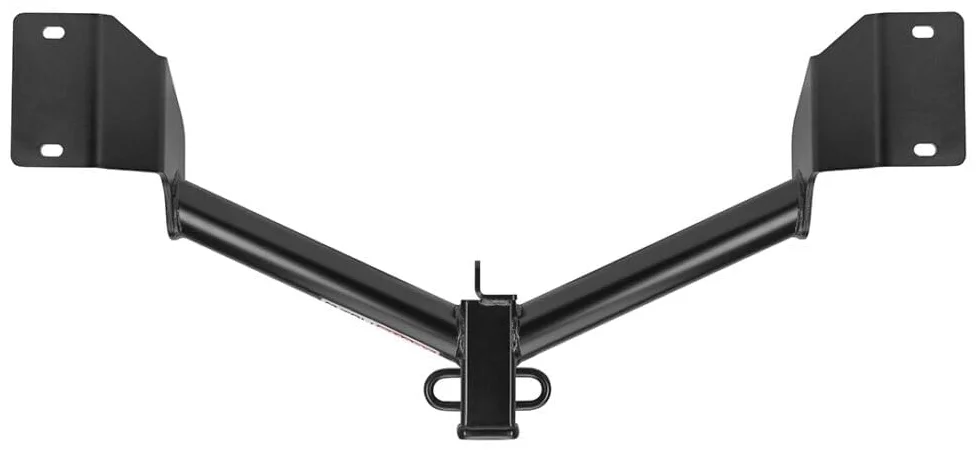
For a 5,000 lb trailer you typically need a Class III hitch. Class II tops out around 3,500 lb, so it is too light, while Class III is commonly rated up to about 8,000 lb gross trailer weight (GTW) and 800 lb tongue weight (TW), which leaves room for a 5,000 lb load.
The class is only a starting point. What matters is the number printed on the hitch label, and the fact that the lowest rated component sets your limit: the vehicle, the hitch, the ball mount, the hitch ball and the trailer coupler. Check your owner's manual for the vehicle's tow rating before you buy anything.
The math: worked example for 5,000 lb
Start with the trailer's loaded weight, not the dry weight in the brochure. Then work out tongue weight, which for a conventional ball-hitch trailer is typically 10 to 15% of the loaded trailer weight.
- Loaded trailer weight: a camper with a 4,200 lb dry weight plus 800 lb of water, propane and gear = 5,000 lb.
- Tongue weight range: 5,000 x 0.10 = 500 lb. 5,000 x 0.15 = 750 lb. Plan for up to 750 lb.
- Hitch needed: rated at least 5,000 lb GTW and 750 lb TW. A typical Class III (up to about 8,000 / 800) clears both.
- Ball and ball mount: each rated at least 5,000 lb, with a ball size that matches the coupler (usually 2 inch at this weight).
- Vehicle: tow rating at least 5,000 lb, and enough payload left to carry 750 lb of tongue weight plus passengers and cargo.
If any one of those numbers comes in lower, that lower number is your real limit.
Which class covers 5,000 lb
| Class | Typical max GTW | Typical max TW | Receiver | 5,000 lb trailer? |
|---|---|---|---|---|
| Class I | 2,000 lb | 200 lb | 1-1/4 inch | No |
| Class II | 3,500 lb | 350 lb | 1-1/4 inch | No |
| Class III | up to about 8,000 lb | up to about 800 lb | 2 inch | Yes, typically |
| Class IV | up to about 10,000 lb | up to about 1,000 lb | 2 inch | Yes, with extra margin |
| Class V | higher | higher | 2 or 2-1/2 inch | Yes, usually heavy-duty trucks |
These are SAE J684 style class ranges. Individual hitches are often rated below the class ceiling because the vehicle they bolt to cannot handle more. Some Class III hitches made for crossovers are rated 5,000 lb or less, so read the label. For the full breakdown see trailer hitch classes.
Common mistakes at 5,000 lb
- Checking GTW but not TW. A hitch rated 6,000 lb GTW but only 600 lb TW is short if your camper puts 750 lb on the ball.
- Using dry weight. Water alone weighs about 8.3 lb per gallon. A full fresh tank, batteries and gear can add several hundred pounds.
- Forgetting the ball and ball mount. A 2 inch ball rated 3,500 lb on a 5,000 lb trailer makes the whole setup a 3,500 lb setup.
- Ignoring payload. Tongue weight counts against your vehicle's payload, the same as passengers and cargo.
- Skipping weight distribution. On a half-ton or SUV, a 5,000 lb travel trailer often tows better with a weight distribution hitch, and some vehicle makers call for one. Check your manual.
How to get a real 5,000 lb number
The 5,000 lb figure only helps if it is accurate, and most people underestimate. The dry weight on a camper's sticker leaves out batteries, propane, water, dealer-added options and everything you pack. Boats are similar: fuel, a trolling motor, batteries, coolers and gear add up quickly.
The simplest fix is a certified truck scale, found at many truck stops, scrap yards and farm supply stores. Pull the trailer on loaded for a trip and weigh the trailer axles alone. That number is your gross trailer weight. If the scale has separate pads, you can also read the truck's steer and drive axles to check them against the door-jamb ratings.
Once you have the real number, run the math again. If the trailer comes in at 5,600 lb rather than 5,000, tongue weight climbs to about 560 to 840 lb, and a Class III hitch rated 6,000 / 600 lb no longer covers it. In that case look for a hitch with a higher TW rating, a Class III that lists a higher weight distributing rating, or a Class IV if one is made for your vehicle. Measure tongue weight directly with the steps in how to calculate tongue weight.
Finally, compare against the vehicle. A crossover rated to tow 5,000 lb is at 100% of its rating with this trailer, which leaves no margin for wind, hills or a heavier load later. Many towers prefer to stay comfortably below the published number.
What else you need
Beyond the receiver, plan on a ball mount and hitch ball sized for a 2 inch receiver, a hitch pin and clip, and the right wiring. Most trailers around 5,000 lb have electric brakes, which need a 7-pin connector and a brake controller. Brake laws vary by state, and many require trailer brakes well below 5,000 lb. See trailer wiring and brake controllers.