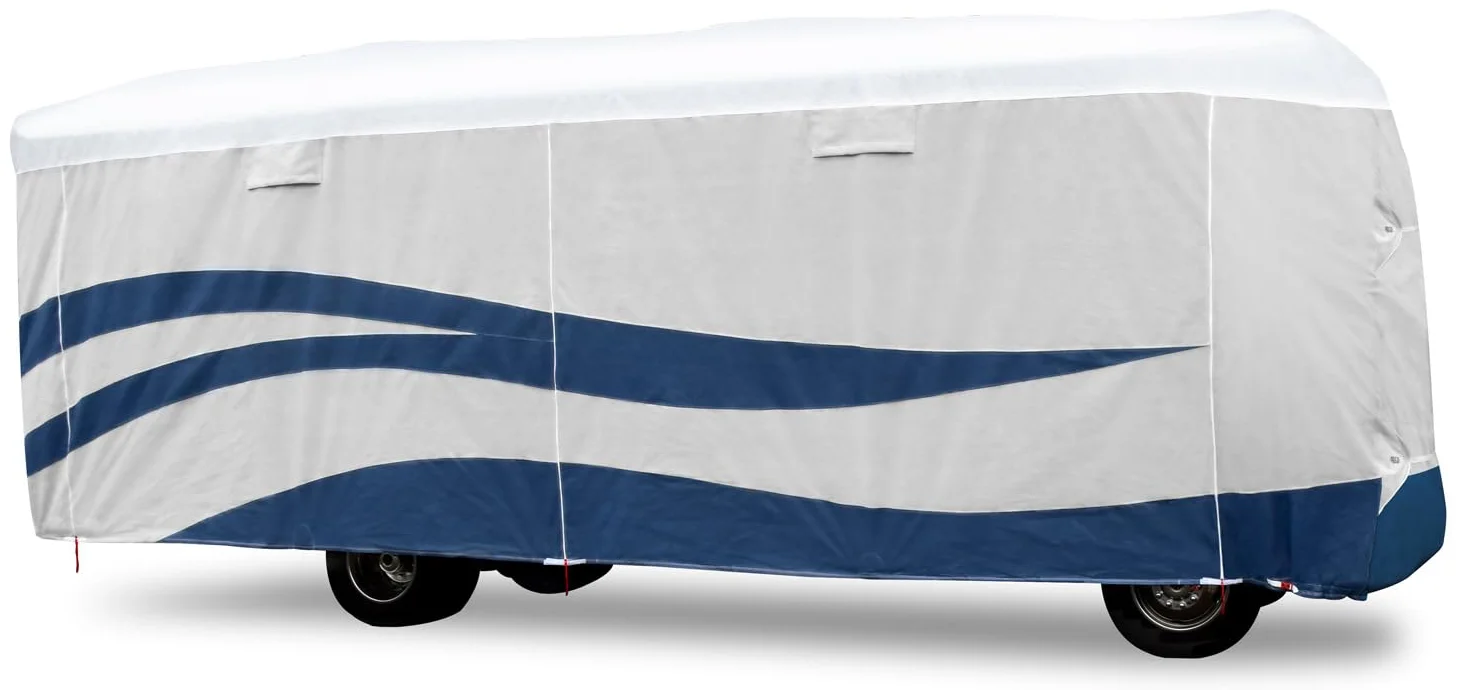
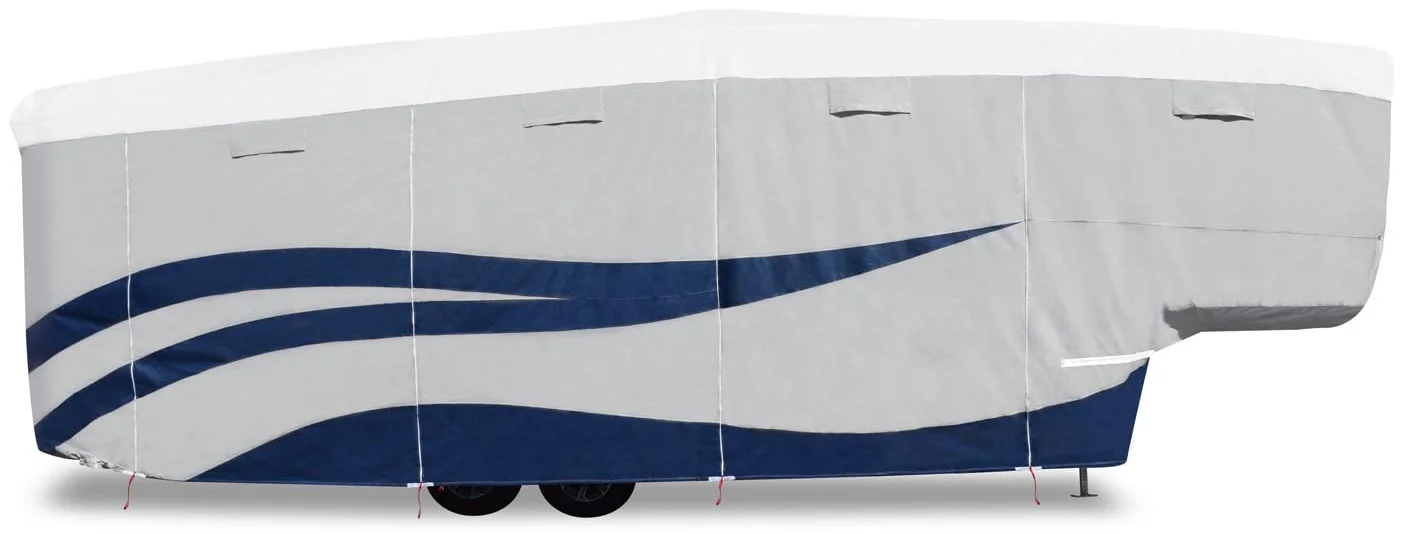
An RV spends most of its life parked. Sun breaks down roof sealant, fades decals and gel coat and dries out tires, while rain, snow and leaves find every seam. A good RV cover slows all of that down, and a few smaller covers protect the parts the big cover misses. This guide covers how to measure for a cover by RV type, what fabric to choose, how to install it without damaging the roof or the cover, and the tire, propane tank and roof vent covers worth adding. Most of what we carry comes from Adco, Classic Accessories and Camco.
Sizing an RV cover by type and length
RV covers are cut for a body style and sold by length range, for example a travel trailer cover for 18 feet 1 inch to 20 feet, or a 5th wheel cover for 29 to 33 feet. Pick the style first, then the length.
| RV type | What the cover accounts for | Examples we carry |
|---|---|---|
| Travel trailer | Box shape, rounded or flat front, A-frame tongue left uncovered | Adco SFS AquaShed, Classic Accessories Encompass travel trailer covers |
| 5th wheel | Raised front cap that sits over the truck bed | Adco Designer Series 5th wheel, Classic Accessories Encompass 5th wheel |
| Pop-up / folding camper | Low, closed box profile | Classic Accessories PolyPro 3 folding camper cover (10 to 12 foot campers) |
| Motorhome (Class A, B, C) | Cab shape; Class C covers include the cab-over bunk | Choose a cover made for your class |
How to measure: the general method is to measure the length from bumper to bumper, leaving out the hitch or tongue, then add for anything that sticks out past the bumper, such as a rear ladder or a spare tire, according to the cover maker's instructions. Each maker has its own guide, so follow the one for the cover you are buying. If you fall between sizes, the maker's chart will tell you which way to go. A cover that is too big flaps in the wind and wears; one that is too small strains the seams.
Also note roof height items such as A/C units and satellite domes, and whether the cover has zippered panels where you need door access.
Fabric: breathable beats waterproof
The most important property of an RV cover is that it breathes. Moisture always gets under a cover, from humidity, condensation or rain blown in at the bottom. A breathable fabric lets it escape. A plastic tarp or a non-breathable cover traps it against the RV, which can lead to mildew, black streaks and damage to decals and finishes.
- Top panel: most quality covers use a heavier, more water-resistant top layer because the roof takes the most sun, rain and snow load.
- Side panels: lighter, breathable fabric on the sides lets air move while blocking UV and dirt.
- Climate: covers are often marketed for sunny, wet or snowy regions. In hot, sunny areas, UV resistance is the priority; in wet climates, water shedding and vents matter most. Read the maker's description and warranty for your use.
- Vents and straps: built-in vents reduce wind billowing and help airflow. Underbody straps and tension panels keep the cover from flapping, which is what wears out covers fastest.
A cover is for storage, not for driving. Never tow or drive with a full RV cover on.
Installing the cover without damage
- Clean and dry the RV first. Dirt under a cover acts like sandpaper as the fabric moves in the wind.
- Pad sharp edges. Gutter corners, ladder ends, roof rails and awning brackets can rub holes in the fabric. Tape or pad them.
- Get the cover up safely. Most covers are rolled out across the roof from the front or rear. Many owners use the RV's ladder and a pole rather than walking on the roof. Only walk on the roof if your RV maker says it is rated for it, and avoid it when wet.
- Center and strap it. Line up any door zippers, then fasten the underbody straps snug, not drum-tight.
- Check after storms. Look for pooling, loose straps and rubbing after wind or snow.
Before long storage, also deploy stabilizers or leveling jacks to take weight off the suspension (see our RV stabilizer and leveling jacks guide), drain and winterize the water system as needed (our RV sewer and water guide covers hoses and fittings), and retract and secure the awning. See our RV awnings guide for awning care.
Tire, propane tank and roof vent covers
A full cover usually stops short of the ground, which leaves the tires in the sun. Sun is one of the main causes of tire dry rot and sidewall cracking, and RV tires often age out before they wear out. Read more in our tire dry rot article and why RV and trailer tires fail differently.
- Tire and wheel covers: sized by tire diameter, such as 27 to 29 inches. Adco Tyre Gard covers come in single, double axle and triple axle versions, and Classic Accessories sells 2-packs, 4-packs and dual-axle covers. Measure the tire's full height and pick the size range that includes it.
- Spare tire covers: vinyl spare covers from Adco, Camco and Classic Accessories are sold by tire diameter and protect the rear-mounted spare.
- Propane tank covers: covers for single and dual 20 lb and 30 lb tanks (Adco, Camco, Classic Accessories, Flame King) keep sun and grime off the tanks and regulator. Make sure the cover fits your tank size and still allows access to the valves.
- Roof vent covers: vent covers like the MaxxAir II, Camco Aero-Flo and Camco roof vent covers mount over a standard roof vent so you can leave it open for airflow in the rain. Check that the cover fits your vent size.
- Plumbing and small vent caps: the small caps over holding tank and plumbing vents, and sidewall vent covers, crack and blow off over time. Replacement caps from Icon Technologies, B&B Molders and RV Designer are inexpensive and keep insects, birds and water out. Match the size and style of the one you are replacing.
Tires on a stored RV also lose pressure over time. Check and set pressure before every trip, and look for cracks in the sidewalls and between the tread blocks.