


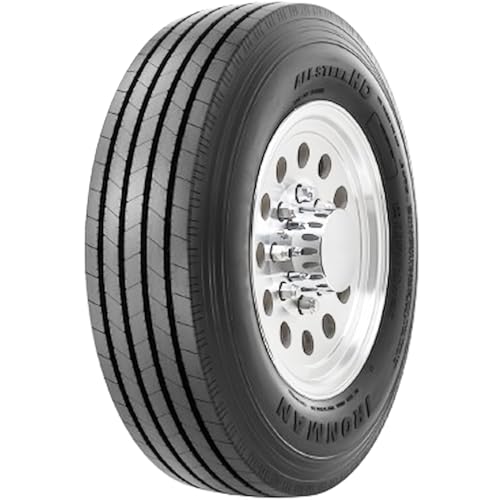
Your trailer already tells you the size: read the VIN plate on the tongue or the sidewall of the tires it came with. That plate lists the original tire size, the cold inflation pressure and the trailer's gross vehicle weight rating (GVWR). Your job is to match the size and make sure the load rating carries the trailer's full weight with room to spare.
The math is simple: tire load capacity x number of tires should be greater than GVWR. Then check that the tire fits the wheel width and the wheel itself is rated for the load and pressure.
ST vs LT trailer tires
ST (special trailer) tires are built for trailers: stiffer sidewalls to resist sway and higher load ratings than a light truck tire of the same size. LT tires are designed for trucks, where traction and ride comfort matter more. Most trailer manufacturers specify ST tires.
Some owners run LT tires on trailers, but an LT tire usually carries less load than an ST tire of the same size, so the load math has to be redone, and some tire makers apply a load reduction when an LT tire is used on a trailer. If you are considering LT, check the tire manufacturer's guidance and the trailer manual first. Never put passenger (P-metric) tires on a trailer.
How to read a trailer tire size
Take ST225/75R15 117/112M Load Range D as an example:
- ST: special trailer service.
- 225: section width in millimeters, about 8.9 inches.
- 75: aspect ratio; sidewall height is 75 percent of the width, about 169 mm.
- R: radial construction. A dash or D instead means bias ply.
- 15: fits a 15 inch wheel.
- 117/112: load index for single and dual mounting.
- M: speed symbol, 81 mph.
- Load Range D: strength rating, typically 8 ply rated at 65 psi max.
Some smaller trailer tires use older formats such as 4.80-12 or 5.70-8, and some heavy trailers use 14.5 inch sizes. Whatever the format, match the size to the trailer's spec and the wheel, and use the max load and pressure printed on the sidewall for your math.
Load range at a glance
Load range is the tire's strength rating. Higher letters carry more weight at higher pressure. Exact capacities depend on the size, so always read the sidewall.
| Load range | Typical ply rating | Typical max psi (ST) | Typical use |
|---|---|---|---|
| B | 4 ply | 35 psi | Small utility and older bias trailers |
| C | 6 ply | 50 psi | Light utility, boat and small camper trailers |
| D | 8 ply | 65 psi | Mid-size campers, cargo and boat trailers |
| E | 10 ply | 80 psi | Larger campers, car haulers, equipment trailers |
For a deeper look with real capacity numbers, see trailer tire load range C vs D vs E.
Worked example: 7,000 lb dual-axle camper
Your tandem-axle travel trailer has a GVWR of 7,000 lb on the VIN plate and runs four ST225/75R15 tires.
- Minimum per tire: 7,000 / 4 = 1,750 lb.
- Add margin: some weight sits on the hitch, but load shifts between tires in turns and on uneven ground, so plan on full GVWR plus about 15 percent: 1,750 x 1.15 = about 2,013 lb per tire.
- Compare options (typical published ST225/75R15 figures, confirm on the sidewall):
| ST225/75R15 | Typical capacity | x 4 tires | Margin over 7,000 lb |
|---|---|---|---|
| Load range C | 2,150 lb at 50 psi | 8,600 lb | About 23 percent |
| Load range D | 2,540 lb at 65 psi | 10,160 lb | About 45 percent |
| Load range E | 2,830 lb at 80 psi | 11,320 lb | About 62 percent |
All three clear the 2,013 lb target, but load range C is close enough that underinflation or a heavy side could eat the margin. Load range D is a common choice here. Before going to E, confirm your wheels are rated for 80 psi and the load; the max psi is usually stamped on the wheel.
Common mistakes
- Sizing to dry weight. Use GVWR. Campers often run close to it once loaded.
- Downgrading load range. Do not go below the load range the trailer came with.
- Overlooking the wheel. A higher load range tire on a lower-rated wheel is limited by the wheel.
- Running low pressure. Load capacity is rated at the sidewall's max pressure. Check cold pressure before every trip.
- Mixing sizes or types on one axle. Keep size, construction and load range matched, at least per axle.
- Ignoring age. Trailer tires often age out before they wear out. Check the DOT date code and the manufacturer's replacement guidance.


