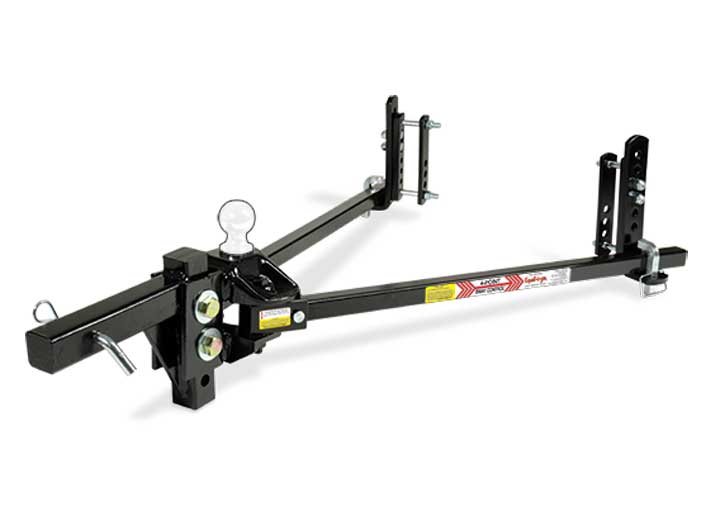


You typically need a weight distribution (WD) hitch when your tongue weight is above the hitch's weight-carrying rating, when your owner's manual requires one above a certain trailer weight, or when the truck squats at the rear and feels light up front. A common rule of thumb is to consider WD for any trailer heavier than about half your vehicle's tow rating.
WD bars lever some tongue weight forward to the front axle and back to the trailer axles. They do not raise any rating. The lowest rated component still sets the limit: vehicle, hitch, ball mount, ball and coupler. Check the manual and labels.
The thresholds to check
| Check | Where to find it | WD typically needed when |
|---|---|---|
| Hitch weight-carrying TW rating | Hitch label | Your tongue weight is higher |
| Hitch weight-distributing rating | Hitch label (if listed) | You need the higher rating to cover GTW or TW |
| Vehicle maker's WD requirement | Owner's manual towing section | Trailer exceeds the stated weight |
| Rule of thumb | Your tow rating | Trailer exceeds about 50% of it |
| Handling | The drive | Rear sag, light steering, headlights aiming high |
Many vehicle manuals give a specific trailer weight above which WD is required, and some say a WD hitch is required to reach the full tow rating. That instruction outranks any rule of thumb.
Worked example
An SUV is rated to tow 7,500 lb. The hitch label reads 5,000 lb GTW / 500 lb TW weight-carrying and 7,500 lb / 750 lb weight-distributing. The travel trailer weighs 6,000 lb loaded.
- Tongue weight: 6,000 x 0.12 = 720 lb (range 600 to 900 lb).
- Weight-carrying check: 6,000 lb is over 5,000 lb and 720 lb is over 500 lb. Fails without WD.
- Weight-distributing check: 6,000 lb is under 7,500 lb and 720 lb is under 750 lb. Passes with WD, though with little margin if TW runs toward 15%.
- Rule of thumb: 6,000 / 7,500 = 80% of tow rating, well over half.
Verdict: this setup needs a WD hitch, sized so the spring bar rating covers the 720 lb tongue weight plus a little. Measure the actual number using our tongue weight guide.
Signs you need one
- The rear drops noticeably when you hitch up, and the front rises.
- Steering feels vague or floaty, and braking feels weaker.
- Oncoming drivers flash you because your headlights aim high.
- The trailer sways or you feel pushed around by passing trucks.
A common way to check is to measure front fender height unhitched, hitched without WD, and hitched with WD. Many WD makers say to restore the front to about half or more of the height it lost, and some vehicle makers give their own target. Follow the instructions for your system and vehicle.
WD hitch types and how they are rated
Weight distribution hitches use spring bars that attach to a head on the shank and to brackets on the trailer frame. When you tension the bars, they lever load off the rear axle of the tow vehicle and spread it to the front axle and the trailer axles. Common designs include:
- Round bar: bars slide into the bottom of the head. Typically lighter and simpler.
- Trunnion bar: bars slide in from the side, which typically gives more ground clearance.
- Integrated 4-point sway control: systems such as Equalizer and Fastway build sway resistance into the head and brackets.
- Friction sway control add-on: a separate bar that bolts between the trailer and the hitch head.
WD kits are rated by tongue weight, often in ranges such as 600, 800, 1,000 or 1,200 lb, with a matching maximum gross trailer weight. Pick the range that covers your loaded tongue weight. Some makers suggest adding the weight of cargo carried behind the vehicle's rear axle, so read the sizing chart for the kit you choose.
The shank, which slides into the receiver, comes in different drops and rises so the trailer can ride level. It must match the receiver size, typically 2 or 2-1/2 inch. Most kits need a separate hitch ball sized to the coupler and rated for the trailer, so check what the kit includes before you order.
Common mistakes
- Bars rated far above tongue weight. Oversized spring bars ride stiff. Pick a rating that covers your TW without a huge excess.
- Thinking WD adds capacity. It never raises the vehicle tow rating, payload or GCWR.
- Wrong shank size. The shank must match your receiver, 2 or 2-1/2 inch.
- Skipping sway control. Integrated or add-on sway control is common on travel trailers. Read more in weight distribution hitches.


