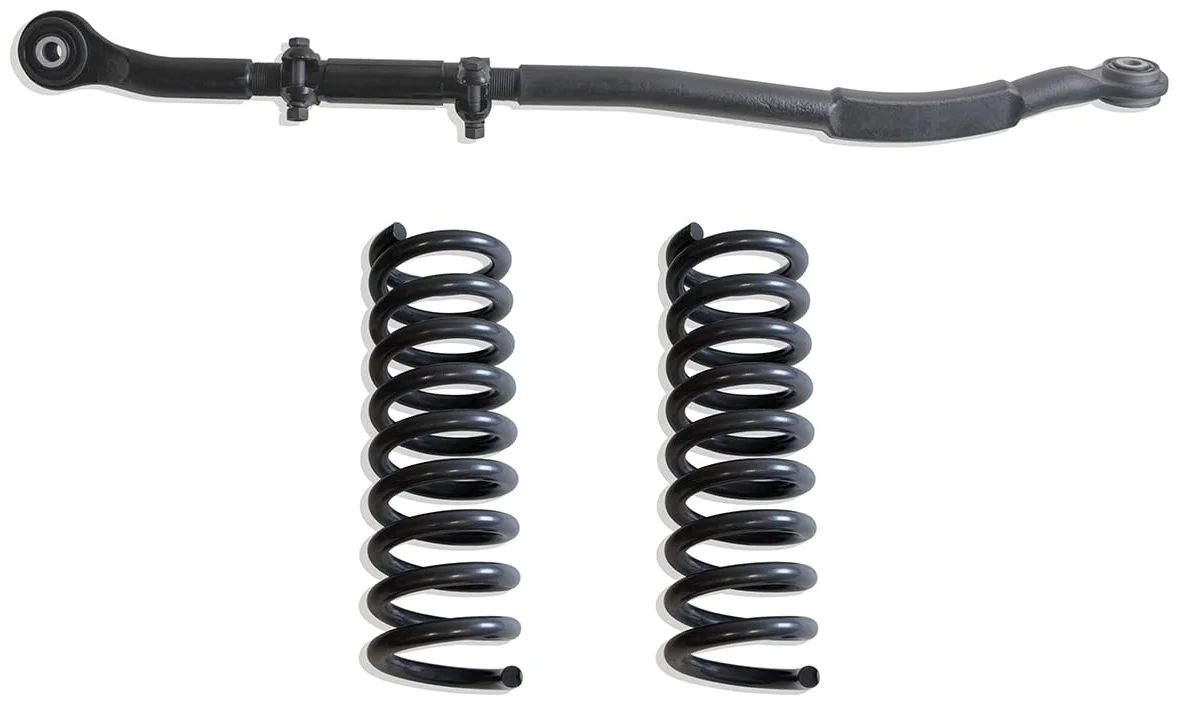
A steering stabilizer (also called a steering damper) is a shock absorber mounted sideways between the axle or frame and the steering linkage. It slows down sudden side-to-side movement of the steering, so a rut, a pothole or a big off-road tire hitting a rock does not yank the wheel out of your hands. On lifted trucks and Jeeps with heavy, oversized tires, a good stabilizer makes the steering feel calmer and less tiring on long drives.
What a stabilizer cannot do is fix worn or loose parts. The violent front-end shake known as death wobble almost always starts with play in the steering or suspension: a tired track bar, loose tie rod ends, worn ball joints or bad wheel bearings. That is why this guide covers the whole steering system we stock, not just dampers: single and dual stabilizers from Fox, Skyjacker, Rancho, Bilstein, Fabtech and Zone Offroad, adjustable track bars from Synergy, JKS, BD Diesel and Zone, and tie rod ends, drag links and sleeves from Moog, Dorman, Crown Automotive and Fabtech.
What a steering stabilizer does (and does not do)
Your steering linkage is a chain of rods and joints connecting the steering box or rack to the wheels. Every bump tries to push the tires left or right, and that force travels back up the linkage to the steering wheel. A stabilizer adds damping to that motion. It does not add stiffness when the steering is still, and it does not hold the wheels straight; it only resists fast movement, the same way a shock resists fast suspension travel.
You will notice a stabilizer most when:
- You run larger or heavier tires than stock, especially aggressive all-terrain or mud-terrain tires.
- The truck is lifted, which changes linkage angles and gives the tires more leverage.
- You drive rutted roads, washboard gravel or trails where the wheel kicks back.
- You plow, tow heavy or carry a lot of weight on the front axle.
On a healthy, stock vehicle a worn-out factory damper can cause a vague, wandering feel, and a fresh replacement such as a Bilstein 5100 or Rancho RS5000 often brings back the original steering. On a heavily modified rig, an upgraded or dual setup can make a big difference in comfort.
The death wobble warning: if the front end shakes violently after hitting a bump, usually at highway speeds, and you have to slow down almost to a stop to make it end, a new stabilizer may make it happen less often, but the cause is still there. Inspect the linkage first. Masking a loose track bar or tie rod with a stronger damper lets the wear get worse.
Single, dual and through-shaft stabilizers compared
| Type | How it works | Best for | Trade-offs |
|---|---|---|---|
| OE-style single | One damper in the factory location | Stock or mildly modified trucks, replacing a worn original | Limited control with big tires |
| Heavy-duty single | Larger body, stiffer valving, sometimes a protective boot | Leveled trucks and Jeeps on moderately larger tires | Slightly firmer steering feel |
| Dual kit | Two dampers, often mounted on opposite sides of the tie rod | Lifted trucks on 35" and larger tires, plow trucks | More parts, may need specific brackets or tie rod clamps |
| Through-shaft | Shaft passes through both ends of the body, so displacement is equal both ways | Performance builds where you want no steering bias | Higher price |
Most conventional gas-charged stabilizers push their shaft outward a little because of the gas charge. On some trucks that can create a slight pull or make the steering wheel sit off-center. Through-shaft designs, such as the Fox 2.0 Through Shaft units for the Wrangler JK and Super Duty, are built to avoid that bias. Fox also offers IFP (internal floating piston) and adjustable ATS race-series stabilizers.
Dual kits from Skyjacker, Fabtech and Zone Offroad mount two dampers so the force is balanced across the linkage. Skyjacker sells several finishes, including Black MAX and the machined aluminum ADX 2.0 line, plus single kits with colored boots. Check whether a kit is application-specific or universal; universal kits usually need you to confirm clamp size against your tie rod diameter.
Track bars, tie rods and the real causes of death wobble
Death wobble mostly affects vehicles with a solid front axle: Jeep Wranglers and Gladiators, Ram and Ford Super Duty 4x4s, and older solid-axle trucks. The axle is located side to side by a track bar (also called a panhard bar). When the bushings or ball joint end of that bar wear, or its bolts loosen, the axle can shift side to side and start an oscillation. Common causes, roughly in the order mechanics check them:
- Track bar ends, bushings and mounting bolts, including elongated bolt holes in the brackets.
- Tie rod ends and drag link ends with play you can feel by hand while someone rocks the steering wheel.
- Ball joints and wheel bearings (unit bearings on many trucks).
- Caster and alignment, especially after a lift, plus tire balance and out-of-round tires.
- A worn steering box mount or sector shaft area; JKS makes a sector shaft reinforcement kit for the JK for this reason.
A lift changes axle position. Because the track bar runs at an angle, raising the truck pulls the axle toward one side. An adjustable track bar from Synergy, JKS, BD Diesel or Zone Offroad lets you re-center the axle under the vehicle, and heavy-duty versions use stronger joints than the factory piece. Weld-on track bar relocation brackets restore a flatter bar angle on taller lifts; welding should be done by someone qualified.
If you replace tie rod ends, a drag link or a track bar, plan on an alignment afterward. Toe changes the moment you thread a new end onto a sleeve. Read our guides to camber, caster and toe and how often to align, and if your tires are already feathered or cupped, see why tires wear unevenly.
Choosing tie rods, drag links and fitment tips
Tie rod ends are wear items on every vehicle, from a Nissan Armada to a Silverado. For daily drivers, an OE-quality replacement is usually all you need. Moog covers a huge range of trucks and SUVs, and its Problem Solver line is designed with upgrades over some original parts; Dorman and Crown Automotive offer value replacements, with Crown focused on Jeep CJ, YJ, TJ, XJ, ZJ and JK applications. Buy inner and outer ends by side and position as listed, and replace adjusting sleeves if they are rusted or seized.
For lifted Jeeps and heavy-duty trucks running big tires, heavy-duty tie rods and drag links from Synergy, Fabtech and Skyjacker use thicker tubes (chromoly on some Synergy parts) and larger joints that resist bending. An adjustable drag link also lets you center the steering wheel after a lift.
- Match the exact application. Year, 2WD or 4WD, cab and drivetrain can change the part. Many listings name the model years; confirm against your vehicle before ordering.
- Check tie rod diameter before buying a stabilizer that clamps to it. Larger aftermarket tie rods often need a different clamp than stock.
- Plan the lift as a system. Many lift and leveling kits include or recommend a stabilizer and track bar. Pair the steering upgrades with matched shocks and the right wheel offset, since a lower-offset wheel increases scrub radius and kickback.
- Torque and re-check. Track bar and tie rod hardware should be torqued to spec, then re-checked after the first few hundred miles.
- Boots and bushings. Cheap items like Prothane tie rod boots keep dirt out of joints. If you are choosing bushing materials, see polyurethane vs rubber bushings.