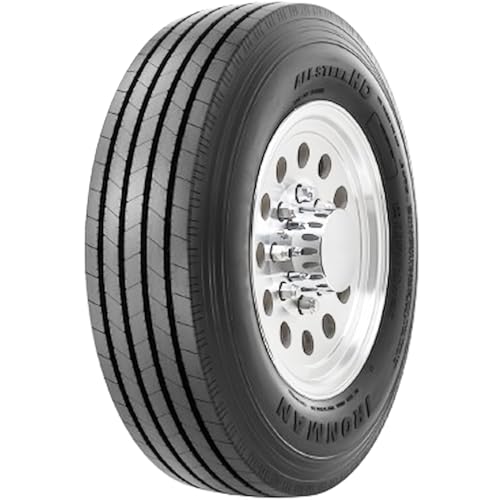
The letter tells you how much weight the tire can carry at its maximum pressure. In the same size, load range C carries the least, D more and E more again. A typical ST225/75R15, for example, goes from about 2,150 lb in C to about 2,830 lb in E.
Modern tires are not literally built with 6, 8 or 10 plies; the ply rating is an equivalent strength figure. What matters is the load and pressure molded into the sidewall. Always confirm those numbers on the actual tire, because they vary by size and brand.
Choosing the letter comes down to three checks: what the trailer's VIN plate specifies, how much the loaded trailer actually weighs compared with total tire capacity, and whether your wheels are rated for the higher pressure a stronger tire needs. The sections below walk through each with real numbers.
Load range C vs D vs E with ST225/75R15 examples
ST225/75R15 is one of the most common trailer tire sizes, so it makes a good reference. The figures below are typical published values; check the sidewall of the tire you buy.
| Load range | Typical ply rating | Typical max psi | Typical max load, ST225/75R15 |
|---|---|---|---|
| C | 6 ply | 50 psi | About 2,150 lb |
| D | 8 ply | 65 psi | About 2,540 lb |
| E | 10 ply | 80 psi | About 2,830 lb |
Other sizes scale differently. A typical ST205/75R14 in load range C is around 1,760 lb, while an ST235/80R16 in load range E is around 3,420 lb. Ranges F and G exist too, typically 95 and 110 psi, for heavy equipment and large fifth wheels.
Worked example: C, D or E for a 5,200 lb boat trailer?
A tandem-axle boat trailer has a GVWR of 5,200 lb and four ST205/75R15 tires. Typical published figures for that size are about 1,820 lb in load range C and about 2,150 lb in load range D.
- Need per tire: 5,200 / 4 = 1,300 lb. With a 15 percent margin: about 1,495 lb.
- Load range C: 1,820 x 4 = 7,280 lb total, about 40 percent over GVWR.
- Load range D: 2,150 x 4 = 8,600 lb total, about 65 percent over GVWR.
Load range C covers this trailer with healthy margin, as long as the tires are kept at their rated pressure. Load range D adds headroom and a stiffer sidewall, at the cost of a firmer ride and higher pressure that your wheels must be rated for. Either works; dropping below what the VIN plate specifies does not.
Why pressure matters as much as the letter
The load on the sidewall is the capacity at the listed max cold pressure. Run a load range E tire at 50 psi and it carries roughly what a load range C tire carries, without the benefit of the higher letter. Tire makers publish load and inflation tables that show capacity at each pressure; if you run less than max, use those tables, not the sidewall maximum.
Also check the wheel. Many trailer wheels are stamped with a max load and max psi. An 80 psi tire on a 65 psi wheel is limited to 65 psi, and so is its capacity.
How to choose the right load range
- Find the minimum. Read the load range and tire size on the VIN plate. That is your floor.
- Do the math. Divide GVWR by the number of tires, add roughly 10 to 20 percent, and compare to the sidewall max load.
- Check the wheels. Confirm the wheel's max load and psi cover the tire you want.
- Weigh ride against headroom. A higher load range runs stiffer at higher pressure. On a light trailer that rarely nears GVWR, the extra stiffness can mean a harsher ride for cargo, while a camper that runs near its limit benefits from the headroom.
- Keep it matched. Replace tires at least in axle pairs, ideally all at once on a tandem.
If you are unsure, step up one load range rather than down, as long as the wheels support it.
Common mistakes
- Comparing load ranges across different sizes. A load range E in one size can carry less than a load range D in a larger size.
- Underinflating to soften the ride. It cuts capacity and builds heat.
- Ignoring dual load numbers. Some sidewalls show two loads; the higher is for dual mounting. Most trailers run singles, so use the single figure.
- Exceeding wheel ratings. Match wheel load and psi to the tire.
- Mixing load ranges on one axle. Keep them matched.